
Vasoactive intestinal peptide test

Blood test
Schedule an Appointment
Definition
Vasoactive intestinal peptide (VIP) test is a test that measures the amount of VIP in the blood.
How the Test is Performed
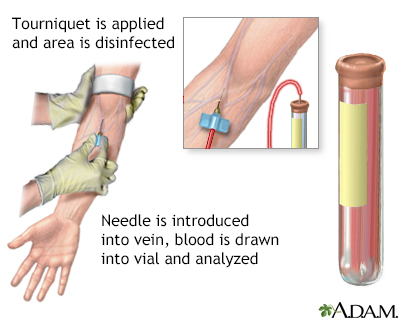
A blood sample is needed.
How to Prepare for the Test
You should not eat or drink anything for 4 hours before the test.
How the Test Will Feel
When the needle is inserted to draw blood, some people feel moderate pain. Others feel only a prick or stinging. Afterward, there may be some throbbing or a slight bruise. This soon goes away.
Why the Test is Performed
This test is used to measure the VIP level in the blood. A very high level is usually caused by a VIPoma. This is an extremely rare tumor that releases VIP.
VIP is a substance found in cells throughout the body. The highest levels are normally found in cells in the nervous system and gut. VIP has many functions, including relaxing certain muscles, triggering the release of hormones from the pancreas, gut, and hypothalamus, and increasing the amount of water and electrolytes secreted from the pancreas and gut.
VIPomas produce and release VIP into the blood. This blood test checks the amount of VIP in the blood to see if a person has a VIPoma.
Other blood tests including serum potassium may be done at the same time as the VIP test.
Normal Results
Normal values should be less than 75 pg/mL (22.2 pmol/L).
People with VIP-secreting tumors usually have values 3 to 10 times above the normal range.
Normal value ranges may vary slightly among different labs. Some labs use different measurements or test different samples. Talk to your provider about the meaning of your specific test results.
What Abnormal Results Mean
A higher-than-normal level, along with symptoms of watery diarrhea and flushing, may be a sign of a VIPoma.
Moderately elevated levels can be caused by other diseases of the gut, including irritation of the gut lining and decreased blood flow in the gut.
Risks
There is little risk involved with having your blood taken. Veins and arteries vary in size from one person to another and from one side of the body to the other. Taking blood from some people may be more difficult than from others.
Other risks associated with having blood drawn are slight but may include:
- Excessive bleeding
- Fainting or feeling lightheaded
- Multiple punctures to locate veins
- Hematoma (blood accumulating under the skin)
- Infection (a slight risk any time the skin is broken)
References
Bohórquez DV, Liddle RA. Gut sensory transduction. In: Feldman M, Friedman LS, Brandt LJ, eds. Sleisenger and Fordtran's Gastrointestinal and Liver Disease: Pathophysiology/Diagnosis/Management. 11th ed. Philadelphia, PA: Elsevier; 2021:chap 4.
De Herder WW, Feelders RA, Hofland J. Neuroendocrine tumors and disorders. In: Melmed S, Auchus, RJ, Goldfine AB, Rosen CJ, Kopp PA, eds. Williams Textbook of Endocrinology. 15th ed. Philadelphia, PA: Elsevier; 2025:chap 43.
Siddiqi HA, Rabinowitz S, Axiotis CA . Laboratory diagnosis of gastrointestinal and pancreatic disorders. In: McPherson RA, Pincus MR, eds. Henry's Clinical Diagnosis and Management by Laboratory Methods. 24th ed. Philadelphia, PA: Elsevier; 2022:chap 23.

Review Date: 7/13/2025
Reviewed By: Sandeep K. Dhaliwal, MD, board-certified in Diabetes, Endocrinology, and Metabolism, Springfield, VA. Also reviewed by David C. Dugdale, MD, Medical Director, Brenda Conaway, Editorial Director, and the A.D.A.M. Editorial team.
The information provided herein should not be used during any medical emergency or for the diagnosis or treatment of any medical condition. A licensed medical professional should be consulted for diagnosis and treatment of any and all medical conditions. Links to other sites are provided for information only -- they do not constitute endorsements of those other sites. No warranty of any kind, either expressed or implied, is made as to the accuracy, reliability, timeliness, or correctness of any translations made by a third-party service of the information provided herein into any other language.
© 1997-
A.D.A.M., a business unit of Ebix, Inc. Any duplication or distribution of the information contained herein is strictly prohibited.
All content on this site including text, images, graphics, audio, video, data, metadata, and compilations is protected by copyright and other intellectual property laws. You may view the content for personal, noncommercial use. Any other use requires prior written consent from Ebix. You may not copy, reproduce, distribute, transmit, display, publish, reverse-engineer, adapt, modify, store beyond ordinary browser caching, index, mine, scrape, or create derivative works from this content. You may not use automated tools to access or extract content, including to create embeddings, vectors, datasets, or indexes for retrieval systems. Use of any content for training, fine-tuning, calibrating, testing, evaluating, or improving AI systems of any kind is prohibited without express written consent. This includes large language models, machine learning models, neural networks, generative systems, retrieval-augmented systems, and any software that ingests content to produce outputs. Any unauthorized use of the content including AI-related use is a violation of our rights and may result in legal action, damages, and statutory penalties to the fullest extent permitted by law. Ebix reserves the right to enforce its rights through legal, technological, and contractual measures.
 All rights reserved