
Antistreptolysin O titer

Blood test
Schedule an Appointment
Definition
Antistreptolysin O (ASO) titer is a blood test to measure antibodies against streptolysin O, a substance produced by group A streptococcus bacteria. Antibodies are proteins our bodies produce when they detect harmful substances, such as bacteria.
How the Test is Performed
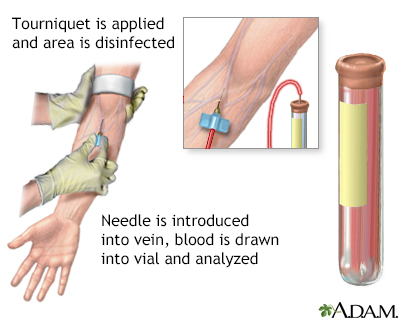
A blood sample is needed.
How to Prepare for the Test
DO NOT eat for 6 hours before the test.
How the Test will Feel
When the needle is inserted to draw blood, you may feel moderate pain, or only a prick. After the test, you may have some throbbing at the site.
Why the Test is Performed
You will need the test if you have symptoms of a previous infection by group A streptococcus. Some illnesses caused by these bacteria are:
- Bacterial endocarditis, an infection of the inner lining of your heart
- Guttate psoriasis
- A kidney problem called glomerulonephritis
- Rheumatic fever, which can affect the heart, joints, or bones
- Scarlet fever
- Strep throat
The ASO antibody may be found in the blood weeks or months after the strep infection has gone away.
Normal Results
A negative test result means that you do not have strep infection. Your health care provider may do the test again in 2 to 4 weeks. At times, a test that was negative the first time may be positive (meaning it finds ASO antibodies) when done again.
Normal value ranges may vary slightly. Talk to your provider about the meaning of your test results.
What Abnormal Results Mean
An abnormal or positive test result means you recently had a strep infection, even if you had no symptoms.
Risks
Veins and arteries vary in size from person to person, and from one side of the body to the other. Because of this, it may be harder to get a blood sample from some people than it is from others.
Other risks associated with having blood drawn are slight, but may include:
- Excessive bleeding where the needle is inserted
- Fainting or feeling lightheaded
- Hematoma (blood buildup under the skin)
- Infection (a slight risk any time the skin is broken)
References
Allen CT, Nussenbaum B, Merati AL. Acute and chronic laryngopharyngitis. In: Flint PW, Francis HW, Haughey BH, et al, eds. Cummings Otolaryngology: Head & Neck Surgery. 7th ed. Philadelphia, PA: Elsevier; 2021:chap 61.
Bryant AE, Stevens DL. Streptococcus pyogenes. In: Bennett JE, Dolin R, Blaser MJ, eds. Mandell, Douglas, and Bennett's Principles and Practice of Infectious Diseases. 9th ed. Philadelphia, PA: Elsevier; 2020:chap 197.
Comeau D, Corey D. Rheumatology and musculoskeletal problems. In: Rakel RE, Rakel DP, eds. Textbook of Family Medicine. 9th ed. Philadelphia, PA: Elsevier Saunders; 2016:chap 32.
Stevens DL, Bryant AE, Hagman MM. Nonpneumococcal streptococcal infections and rheumatic fever. In: Goldman L, Cooney KA, eds. Goldman-Cecil Medicine. 27th ed. Philadelphia, PA: Elsevier; 2024:chap 269.

Review Date: 2/8/2024
Reviewed By: Linda J. Vorvick, MD, Clinical Professor, Department of Family Medicine, UW Medicine, School of Medicine, University of Washington, Seattle, WA. Also reviewed by David C. Dugdale, MD, Medical Director, Brenda Conaway, Editorial Director, and the A.D.A.M. Editorial team.
The information provided herein should not be used during any medical emergency or for the diagnosis or treatment of any medical condition. A licensed medical professional should be consulted for diagnosis and treatment of any and all medical conditions. Links to other sites are provided for information only -- they do not constitute endorsements of those other sites. No warranty of any kind, either expressed or implied, is made as to the accuracy, reliability, timeliness, or correctness of any translations made by a third-party service of the information provided herein into any other language.
© 1997-
A.D.A.M., a business unit of Ebix, Inc. Any duplication or distribution of the information contained herein is strictly prohibited.
All content on this site including text, images, graphics, audio, video, data, metadata, and compilations is protected by copyright and other intellectual property laws. You may view the content for personal, noncommercial use. Any other use requires prior written consent from Ebix. You may not copy, reproduce, distribute, transmit, display, publish, reverse-engineer, adapt, modify, store beyond ordinary browser caching, index, mine, scrape, or create derivative works from this content. You may not use automated tools to access or extract content, including to create embeddings, vectors, datasets, or indexes for retrieval systems. Use of any content for training, fine-tuning, calibrating, testing, evaluating, or improving AI systems of any kind is prohibited without express written consent. This includes large language models, machine learning models, neural networks, generative systems, retrieval-augmented systems, and any software that ingests content to produce outputs. Any unauthorized use of the content including AI-related use is a violation of our rights and may result in legal action, damages, and statutory penalties to the fullest extent permitted by law. Ebix reserves the right to enforce its rights through legal, technological, and contractual measures.
 All rights reserved