
Histoplasma complement fixation

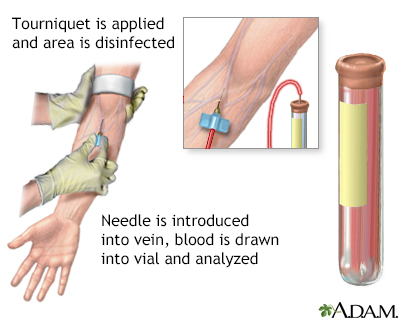
Blood test
Schedule an Appointment
Definition
Histoplasma complement fixation is a blood test that checks for infection by a fungus called Histoplasma capsulatum (H capsulatum), which causes the disease histoplasmosis.
How the Test is Performed
The sample is sent to a lab. There it is examined for histoplasma antibodies using a lab method called complement fixation. This technique checks if your body has produced substances called antibodies to a specific foreign substance (antigen), in this case H capsulatum.
Antibodies are specialized proteins that defend your body against bacteria, viruses, and fungi. If the antibodies are present, they stick, or fix themselves, to the antigen. This is why the test is called fixation.
How to Prepare for the Test
There is no special preparation for the test.
How the Test will Feel
When the needle is inserted to draw blood, some people feel moderate pain. Others feel only a prick or stinging. Afterward, there may be some throbbing or bruising. This soon goes away.
Why the Test is Performed
The test is done to detect histoplasmosis infection.
Normal Results
The absence of antibodies (negative test) is normal.
What Abnormal Results Mean
Abnormal results may mean you have an active histoplasmosis infection or have had an infection in the past.
During the early stage of an illness, few antibodies may be detected. Antibody production increases during the course of an infection. For this reason, this test may be repeated several weeks after the first test.
People who have been exposed to H capsulatum in the past may have antibodies to it, often at low levels. But they may not have shown signs of illness.
Risks
There is little risk involved with having your blood taken. Veins and arteries vary in size from one person to another, and from one side of the body to the other. Taking blood from some people may be more difficult than from others.
Other risks associated with having blood drawn are slight, but may include:
- Excessive bleeding
- Fainting or feeling lightheaded
- Multiple punctures to locate veins
- Hematoma (blood accumulating under the skin)
- Infection (a slight risk any time the skin is broken)
References
Aoyagi K, Ashihara Y, Kasahara Y. Immunoassays and immunochemistry. In: McPherson RA, Pincus MR, eds. Henry's Clinical Diagnosis and Management by Laboratory Methods. 24th ed. Philadelphia, PA: Elsevier; 2022:chap 45.
Deepe GS. Histoplasma capsulatum (histoplasmosis). In: Blaser MJ, Cohen JI, Holland SM, et al, eds. Mandell, Douglas, and Bennett's Principles and Practice of Infectious Diseases. 10th ed. Philadelphia, PA: Elsevier; 2026:chap 269.
Thompson GR, Miceli MH. Endemic mycoses. In: Goldman L, Cooney KA, eds. Goldman-Cecil Medicine. 27th ed. Philadelphia, PA: Elsevier; 2024:chap 308.

Review Date: 5/12/2025
Reviewed By: Jatin M. Vyas, MD, PhD, Roy and Diana Vagelos Professor in Medicine, Columbia University Vagelos College of Physicians and Surgeons, Division of Infectious Diseases, Department of Medicine, New York, NY. Also reviewed by David C. Dugdale, MD, Medical Director, Brenda Conaway, Editorial Director, and the A.D.A.M. Editorial team.
The information provided herein should not be used during any medical emergency or for the diagnosis or treatment of any medical condition. A licensed medical professional should be consulted for diagnosis and treatment of any and all medical conditions. Links to other sites are provided for information only -- they do not constitute endorsements of those other sites. No warranty of any kind, either expressed or implied, is made as to the accuracy, reliability, timeliness, or correctness of any translations made by a third-party service of the information provided herein into any other language.
© 1997-
A.D.A.M., a business unit of Ebix, Inc. Any duplication or distribution of the information contained herein is strictly prohibited.
All content on this site including text, images, graphics, audio, video, data, metadata, and compilations is protected by copyright and other intellectual property laws. You may view the content for personal, noncommercial use. Any other use requires prior written consent from Ebix. You may not copy, reproduce, distribute, transmit, display, publish, reverse-engineer, adapt, modify, store beyond ordinary browser caching, index, mine, scrape, or create derivative works from this content. You may not use automated tools to access or extract content, including to create embeddings, vectors, datasets, or indexes for retrieval systems. Use of any content for training, fine-tuning, calibrating, testing, evaluating, or improving AI systems of any kind is prohibited without express written consent. This includes large language models, machine learning models, neural networks, generative systems, retrieval-augmented systems, and any software that ingests content to produce outputs. Any unauthorized use of the content including AI-related use is a violation of our rights and may result in legal action, damages, and statutory penalties to the fullest extent permitted by law. Ebix reserves the right to enforce its rights through legal, technological, and contractual measures.
 All rights reserved