Urine pH test
pH - urine
A urine pH test measures the level of acid in urine.
Images

How the Test is Performed
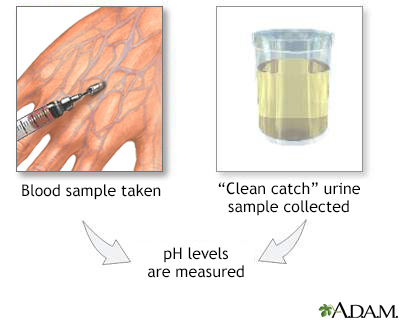
After you provide a urine sample, it can be tested right away. The health care provider uses a dipstick made with a color-sensitive pad. The color on the dipstick tells the provider the level of acid in your urine.
How to Prepare for the Test
Your provider may tell you to stop taking certain medicines that can affect the results of the test. These may include:
- Acetazolamide
- Ammonium chloride
- Methenamine mandelate
- Potassium citrate
- Sodium bicarbonate
- Thiazide diuretic
DO NOT stop taking any medicine before talking to your provider.
Eat a normal, balanced diet for several days before the test. Note that:
- A diet high in fruits, vegetables, or non-cheese dairy products can increase your urine pH.
- A diet high in fish, meat products, or cheese can decrease your urine pH.
How the Test will Feel
The test involves only normal urination. There is no discomfort.
Why the Test is Performed
Your provider may order this test to check for changes in your urine acid levels. It may be done to see if you:
- Are at risk of kidney stones. Different types of stones can form depending on how acidic your urine is.
- Have a metabolic condition, such as renal tubular acidosis.
- Need to take certain medicines to treat urinary tract infections. Some medicines are more effective when urine is acidic or non-acidic (alkaline).
Normal Results
The normal values range from pH 4.6 to 8.0.
The examples above are common measurements for results of these tests. Normal value ranges may vary slightly among different laboratories. Some labs use different measurements or test different samples. Talk to your provider about the meaning of your specific test results.
What Abnormal Results Mean
A high urine pH may be due to:
- Kidneys that do not properly remove acids from the bloodstream (renal tubular acidosis)
- Kidney failure
- Stomach pumping (gastric suction to remove fluid from the stomach)
- Urinary tract infection
- Vomiting
A low urine pH may be due to:
- Diarrhea
- Too much acid in the body fluids (metabolic acidosis), such as diabetic ketoacidosis
- Starvation
Risks
There are no risks with this test.
Related Information
Acid loading test (pH)Kidney stones
Uric acid - blood
Urinary tract infection - adults
Gastric suction
Acute kidney failure
Proximal renal tubular acidosis
Nausea and vomiting – adults
Chronic obstructive pulmonary disease (COPD)
Diabetic ketoacidosis
Diarrhea
Alkalosis
Interstitial nephritis
Distal renal tubular acidosis
Sepsis
References
Gharavi AG, Landry DW. Approach to the patient with renal disease. In: Goldman L, Cooney KA, eds. Goldman-Cecil Medicine. 27th ed. Philadelphia, PA: Elsevier; 2024:chap 100.
Hamm LL, DuBose TD. Disorders of acid-base balance. In: Yu ASL, Chertow GM, Luyckx VA, Marsden PA, Skorecki K, Taal MW, eds. Brenner and Rector's The Kidney. 11th ed. Philadelphia, PA: Elsevier; 2020:chap 16.
Kamel KS, Halperin ML. Interpretation of electrolyte and acid-base parameters in blood and urine. In: Yu ASL, Chertow GM, Luyckx VA, Marsden PA, Skorecki K, Taal MW, eds. Brenner and Rector's The Kidney. 11th ed. Philadelphia, PA: Elsevier; 2020:chap 24.
Riley RS, McPherson RA. Basic examination of urine. In: McPherson RA, Pincus MR, eds. Henry's Clinical Diagnosis and Management by Laboratory Methods. 24th ed. Philadelphia, PA: Elsevier; 2022:chap 29.
Seifter JL. Acid-base disorders. In: Goldman L, Cooney KA, eds. Goldman-Cecil Medicine. 27th ed. Philadelphia, PA: Elsevier; 2024:chap 104.
BACK TO TOPReview Date: 7/13/2025
Reviewed By: Laura J. Martin, MD, MPH, ABIM Board Certified in Internal Medicine and Hospice and Palliative Medicine, Atlanta, GA. Also reviewed by David C. Dugdale, MD, Medical Director, Brenda Conaway, Editorial Director, and the A.D.A.M. Editorial team.

Health Content Provider
06/01/2028
|
A.D.A.M., Inc. is certified by URAC, for Health Content Provider (www.urac.org). URAC's certification program is an independent audit to verify that A.D.A.M. follows rigorous standards of quality and accountability. A.D.A.M. is among the first to achieve this important distinction for online health information and services. Learn more about A.D.A.M.'s editorial policy, editorial process and privacy policy. |
The information provided herein should not be used during any medical emergency or for the diagnosis or treatment of any medical condition. A licensed medical professional should be consulted for diagnosis and treatment of any and all medical conditions. Links to other sites are provided for information only -- they do not constitute endorsements of those other sites. © 1997- 2026 A.D.A.M., a business unit of Ebix, Inc. Any duplication or distribution of the information contained herein is strictly prohibited.
 All rights reserved.