
Quantitative Bence-Jones protein test

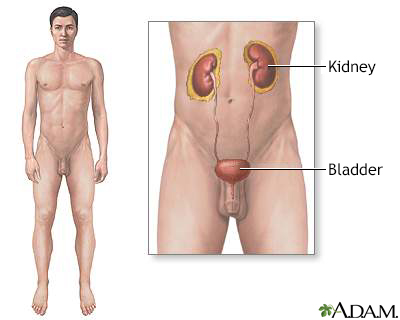
Male urinary system
Schedule an Appointment
Definition
This test measures the level of abnormal proteins called Bence-Jones proteins in the urine.
How the Test is Performed
A clean-catch urine sample is needed. The clean-catch method is used to prevent germs from the penis or vagina from getting into a urine sample. To collect your urine, your health care provider may give you a special clean-catch kit that contains a cleansing solution and sterile wipes. Follow instructions exactly so that the results are accurate.
The sample is sent to the lab. There are many methods used to detect Bence-Jones proteins. One method, called immunoelectrophoresis, is the most accurate.
How the Test will Feel
The test involves only normal urination, and there is no discomfort.
Why the Test is Performed
Bence-Jones proteins are a part of regular antibodies called light chains. These proteins are not normally in urine. Sometimes, when your body makes too many antibodies, the level of light chains also rises. Bence-Jones proteins are small enough to be filtered out by the kidneys. The proteins then spill into the urine.
Your provider may order this test:
- To diagnose conditions that lead to protein in the urine
- If you have a lot of protein in your urine
- If you have signs of a blood cancer called multiple myeloma
Normal Results
A normal result means no Bence-Jones proteins are found in your urine.
What Abnormal Results Mean
Bence-Jones proteins are rarely found in urine. If they are, it is usually associated with multiple myeloma.
An abnormal result may also be due to:
- An abnormal buildup of proteins in tissues and organs (amyloidosis)
- Blood cancer called chronic lymphocytic leukemia
- Lymph system cancer (lymphoma)
- Buildup in the blood of a protein called M-protein (monoclonal gammopathy of unknown significance; MGUS)
- Chronic renal failure
Risks
There are no risks with this test.
References
Gertz MA, Dispenzieri A. Amyloidosis. In: Goldman L, Cooney KA, eds. Goldman-Cecil Medicine. 27th ed. Philadelphia, PA: Elsevier; 2024:chap 174.
Rajkumar SV, Dispenzieri A. Multiple myeloma and related disorders. In: Niederhuber JE, Armitage JO, Kastan MB, Doroshow JH, Tepper JE, eds. Abeloff's Clinical Oncology. 6th ed. Philadelphia, PA: Elsevier; 2020:chap 101.
Riley RS, McPherson RA. Basic examination of urine. In: McPherson RA, Pincus MR, eds. Henry's Clinical Diagnosis and Management by Laboratory Methods. 24th ed. Philadelphia, PA: Elsevier; 2022:chap 29.

Review Date: 6/17/2024
Reviewed By: Todd Gersten, MD, Hematology/Oncology, Florida Cancer Specialists & Research Institute, Wellington, FL. Review provided by VeriMed Healthcare Network. Also reviewed by David C. Dugdale, MD, Medical Director, Brenda Conaway, Editorial Director, and the A.D.A.M. Editorial team.
The information provided herein should not be used during any medical emergency or for the diagnosis or treatment of any medical condition. A licensed medical professional should be consulted for diagnosis and treatment of any and all medical conditions. Links to other sites are provided for information only -- they do not constitute endorsements of those other sites. No warranty of any kind, either expressed or implied, is made as to the accuracy, reliability, timeliness, or correctness of any translations made by a third-party service of the information provided herein into any other language.
© 1997-
A.D.A.M., a business unit of Ebix, Inc. Any duplication or distribution of the information contained herein is strictly prohibited.
All content on this site including text, images, graphics, audio, video, data, metadata, and compilations is protected by copyright and other intellectual property laws. You may view the content for personal, noncommercial use. Any other use requires prior written consent from Ebix. You may not copy, reproduce, distribute, transmit, display, publish, reverse-engineer, adapt, modify, store beyond ordinary browser caching, index, mine, scrape, or create derivative works from this content. You may not use automated tools to access or extract content, including to create embeddings, vectors, datasets, or indexes for retrieval systems. Use of any content for training, fine-tuning, calibrating, testing, evaluating, or improving AI systems of any kind is prohibited without express written consent. This includes large language models, machine learning models, neural networks, generative systems, retrieval-augmented systems, and any software that ingests content to produce outputs. Any unauthorized use of the content including AI-related use is a violation of our rights and may result in legal action, damages, and statutory penalties to the fullest extent permitted by law. Ebix reserves the right to enforce its rights through legal, technological, and contractual measures.
 All rights reserved