
Catecholamines - urine


Definition
Catecholamines are chemicals made by nerve tissue (including the brain) and the adrenal gland.
The main types of catecholamines are dopamine, norepinephrine, and epinephrine. These chemicals break down into other components, which leave your body through your urine.
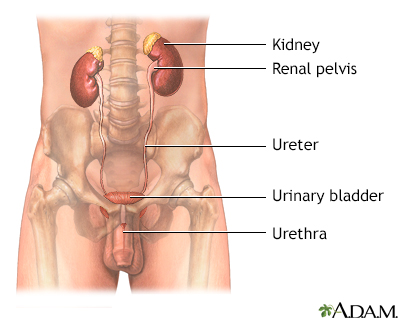
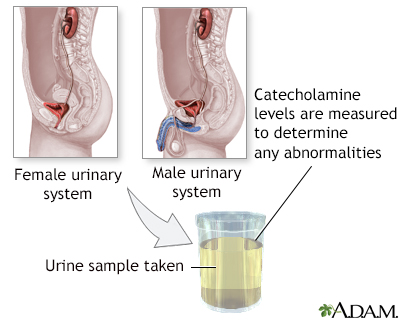
A urine test can be done to measure the amount of catecholamines produced by your body. Separate urine tests may be done to measure related substances.
Catecholamines can also be measured with a blood test.
How the Test is Performed
For this test, you must collect your urine in a special bag or container every time you urinate for a 24-hour period.
- On day 1, urinate over the toilet when you wake up in the morning and discard that urine.
- Urinate into the special container every time you use the bathroom for the next 24 hours. Keep it in the refrigerator or a cool place during the collection period.
- On day 2, urinate into the container in the morning again when you wake up.
- Label the container with your name, the date, the time of completion, and return it as instructed.
For an infant, thoroughly wash the area where urine exits the body.
- Open a urine collection bag (a plastic bag with an adhesive paper on one end).
- For males, place the entire penis in the bag and attach the adhesive to the skin.
- For females, place the bag over the labia.
- Diaper as usual over the secured bag.
This procedure may take a few tries. An active baby can move the bag causing urine to go into the diaper.
Check the infant often and change the bag after the infant has urinated into it. Drain the urine from the bag into the container provided by your health care provider.
Deliver the sample to the lab or to your provider as soon as possible.
How to Prepare for the Test
Stress and heavy exercise may affect the test results.
Some foods can increase catecholamines in your urine. You may need to avoid the following foods and beverages for several days before the test:
- Bananas
- Chocolate
- Citrus fruits
- Cocoa
- Coffee
- Licorice
- Tea
- Vanilla
Many medicines can interfere with test results.
- Your provider will tell you if you need to stop taking any medicines before you have this test.
- Do not stop or change your medicines without talking to your provider first.
How the Test will Feel
The test involves only normal urination, and there is no discomfort.
Why the Test is Performed
The test is usually done to diagnose an adrenal gland tumor called pheochromocytoma. It may also be used to diagnose a nervous system tumor called neuroblastoma. Urine catecholamine levels are increased in most people with neuroblastoma.
The urine test for catecholamines may also be used to monitor those who are receiving treatment for these conditions.
Normal Results
All of the catecholamines are broken down into inactive substances that appear in the urine:
- Dopamine becomes homovanillic acid (HVA)
- Norepinephrine becomes normetanephrine and vanillylmandelic acid (VMA)
- Epinephrine becomes metanephrine and VMA
The following normal values are the amount of the substance found in the urine over a 24-hour period:
- Dopamine: 71 to 485 micrograms (mcg)/24 hours [464 to 3167 nanomole (nmol)/24 hours]
- Epinephrine: 1 to 14 mcg/24 hours (5 to 76 nmol/24 hours)
- Metanephrine: 24 to 96 mcg/24 hours (some labs give the range as 140 - 785 mcg/24 hours)
- Norepinephrine: 14 to 120 mcg/24 hours (83 to 709 nmol/24 hours)
- Normetanephrine: 75 to 375 mcg/24 hours
- Total urine catecholamines: 14 to 110 mcg/24 hours
- VMA: 0 to 7 milligrams (mg)/24 hours (0 to 35 micromol/24 hours)
Normal value ranges may vary slightly among different labs. Talk to your provider about the meaning of your specific test results.
The examples above show the common measurements for results for these tests. Some labs use different measurements or may test different specimens.
What Abnormal Results Mean
Elevated levels of urinary catecholamines may indicate:
- Acute anxiety or severe stress
- Ganglioneuroblastoma (very rare)
- Ganglioneuroma (very rare)
- Neuroblastoma (rare)
- Pheochromocytoma (rare)
The test may also be performed for:
Risks
There are no risks.
Considerations
Several foods and medicines, as well as physical activity and stress, can affect the accuracy of this test.
References
Guber HA, Oprea M, Russell YX. Evaluation of endocrine function. In: McPherson RA, Pincus MR, eds. Henry's Clinical Diagnosis and Management by Laboratory Methods. 24th ed. Philadelphia, PA: Elsevier; 2022:chap 25.
Young WF. Adrenal medulla, catecholamines, and pheochromocytoma. In: Goldman L, Cooney KA, eds. Goldman-Cecil Medicine. 27th ed. Philadelphia, PA: Elsevier; 2024:chap 209.
Review Date: 7/1/2025
Reviewed By: Frank D. Brodkey, MD, FCCM, Associate Professor, Section of Pulmonary and Critical Care Medicine, University of Wisconsin School of Medicine and Public Health, Madison, WI. Also reviewed by David C. Dugdale, MD, Medical Director, Brenda Conaway, Editorial Director, and the A.D.A.M. Editorial team.
The information provided herein should not be used during any medical emergency or for the diagnosis or treatment of any medical condition. A licensed medical professional should be consulted for diagnosis and treatment of any and all medical conditions. Links to other sites are provided for information only -- they do not constitute endorsements of those other sites. No warranty of any kind, either expressed or implied, is made as to the accuracy, reliability, timeliness, or correctness of any translations made by a third-party service of the information provided herein into any other language.
© 1997-
A.D.A.M., a business unit of Ebix, Inc. Any duplication or distribution of the information contained herein is strictly prohibited.
All content on this site including text, images, graphics, audio, video, data, metadata, and compilations is protected by copyright and other intellectual property laws. You may view the content for personal, noncommercial use. Any other use requires prior written consent from Ebix. You may not copy, reproduce, distribute, transmit, display, publish, reverse-engineer, adapt, modify, store beyond ordinary browser caching, index, mine, scrape, or create derivative works from this content. You may not use automated tools to access or extract content, including to create embeddings, vectors, datasets, or indexes for retrieval systems. Use of any content for training, fine-tuning, calibrating, testing, evaluating, or improving AI systems of any kind is prohibited without express written consent. This includes large language models, machine learning models, neural networks, generative systems, retrieval-augmented systems, and any software that ingests content to produce outputs. Any unauthorized use of the content including AI-related use is a violation of our rights and may result in legal action, damages, and statutory penalties to the fullest extent permitted by law. Ebix reserves the right to enforce its rights through legal, technological, and contractual measures.
 All rights reserved