
T3RU test

Blood test
Schedule an Appointment
Definition
The T3RU test measures the level of proteins that carry thyroid hormone in the blood. This can help your health care provider interpret the results of T3 and T4 blood tests.
Because tests called the free T4 blood test and thyroxine binding globulin (TBG) blood tests are now available, the T3RU test is rarely used these days.
How the Test is Performed
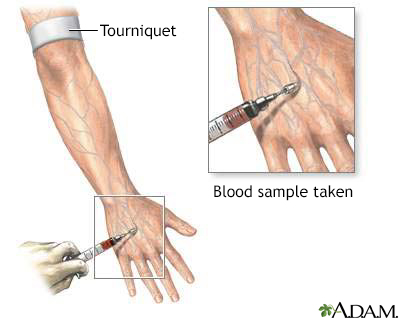
A blood sample is needed.
How to Prepare for the Test
Your provider will tell you if you need to stop taking any medicines before the test that may affect your test result. Do not stop taking any medicine without first talking to your provider.
Some medicines that can increase T3RU levels include:
- Anabolic steroids
- Heparin
- Phenytoin
- Salicylates (high dose)
- Warfarin
Some medicines that can decrease T3RU levels include:
- Antithyroid medicines
- Birth control pills
- Estrogen
- Thiazides
- Opioids and methadone
Pregnancy can also decrease T3RU levels.
These conditions can decrease TBG levels (see below section Why the Test is Performed for more about TBG):
- Serious illness
- Kidney disease when protein is lost in the urine (nephrotic syndrome)
Other medicines that bind to protein in the blood can also affect test results.
How the Test will Feel
When the needle is inserted to draw blood, some people feel moderate pain. Others feel only a prick or stinging. Afterward, there may be some throbbing or a slight bruise. This soon goes away.
Why the Test is Performed
This test is done to check your thyroid function. Thyroid function depends on the action of many different hormones, including thyroid-stimulating hormone (TSH), T3, and T4.
This test helps check the amount of T3 that TBG is able to bind. TBG is a protein that carries most of the T3 and T4 in the blood.
Your provider may recommend a T3RU test if you have signs of a thyroid disorder, including:
- Overactive thyroid (hyperthyroidism)
- Underactive thyroid (hypothyroidism)
- Muscle weakness caused by high levels of thyroid hormone in the blood (thyrotoxic periodic paralysis)
Normal Results
Normal values range from 25% to 38%.
Normal value ranges may vary slightly among different laboratories. Some labs use different measurements or test different samples. Talk to your provider about the meaning of your specific test results.
What Abnormal Results Mean
Higher-than-normal levels may indicate:
- Kidney failure
- Overactive thyroid (hyperthyroidism)
- Nephrotic syndrome
- Protein malnutrition
- Chronic liver disease
Lower-than-normal levels may indicate:
- Acute hepatitis (liver disease)
- Pregnancy
- Hypothyroidism
- Use of estrogen, opioids or methadone
Abnormal results may also be due to an inherited condition of high TBG levels. Usually thyroid function is normal in people with this condition.
This test may also be done for:
- Chronic thyroiditis (swelling or inflammation of the thyroid gland, including Hashimoto disease)
- Drug-induced hypothyroidism
- Graves disease
- Subacute thyroiditis
- Thyrotoxic periodic paralysis
- Toxic nodular goiter
Risks
There is little risk involved with having your blood taken. Veins and arteries vary in size from one person to another and from one side of the body to the other. Obtaining a blood sample from some people may be more difficult than from others.
Other risks associated with having blood drawn are slight, but may include:
- Excessive bleeding
- Fainting or feeling lightheaded
- Multiple punctures to locate veins
- Blood buildup under the skin (hematoma)
- Infection (a slight risk any time the skin is broken)
References
Faix JD. Thyroid function testing (thyrotropin, triiodothyronine, and thyroxine). In: Robertson RP, ed. DeGroot's Endocrinology. 8th ed. Philadelphia, PA: Elsevier; 2023:chap 68.
Guber HA, Oprea M, Rusell YX. Evaluation of endocrine function. In: McPherson RA, Pincus MR, eds. Henry's Clinical Diagnosis and Management by Laboratory Methods. 24th ed. Philadelphia, PA: Elsevier; 2022:chap 25.
Pearce EN, Hollenberg AN. Thyroid. In: Goldman L, Cooney KA, eds. Goldman-Cecil Medicine. 27th ed. Philadelphia, PA: Elsevier; 2024:chap 207.
Salvatore D, Cohen R, Kopp PA, Larsen PR. Thyroid pathophysiology and diagnostic evaluation. In: Melmed S, Auchus RJ, Golfine AB, Koenig RJ, Rosen CJ, eds. Williams Textbook of Endocrinology. 14th ed. Philadelphia, PA: Elsevier; 2020:chap 11.
Wassner AJ, Smith JR. Thyroid development and physiology. In: Kliegman RM, St. Geme JW, Blum NJ, et al, eds. Nelson Textbook of Pediatrics. 22nd ed. Philadelphia, PA: Elsevier; 2025:chap 601.

Review Date: 2/28/2024
Reviewed By: Sandeep K. Dhaliwal, MD, board-certified in Diabetes, Endocrinology, and Metabolism, Springfield, VA. Also reviewed by David C. Dugdale, MD, Medical Director, Brenda Conaway, Editorial Director, and the A.D.A.M. Editorial team.
The information provided herein should not be used during any medical emergency or for the diagnosis or treatment of any medical condition. A licensed medical professional should be consulted for diagnosis and treatment of any and all medical conditions. Links to other sites are provided for information only -- they do not constitute endorsements of those other sites. No warranty of any kind, either expressed or implied, is made as to the accuracy, reliability, timeliness, or correctness of any translations made by a third-party service of the information provided herein into any other language.
© 1997-
A.D.A.M., a business unit of Ebix, Inc. Any duplication or distribution of the information contained herein is strictly prohibited.
All content on this site including text, images, graphics, audio, video, data, metadata, and compilations is protected by copyright and other intellectual property laws. You may view the content for personal, noncommercial use. Any other use requires prior written consent from Ebix. You may not copy, reproduce, distribute, transmit, display, publish, reverse-engineer, adapt, modify, store beyond ordinary browser caching, index, mine, scrape, or create derivative works from this content. You may not use automated tools to access or extract content, including to create embeddings, vectors, datasets, or indexes for retrieval systems. Use of any content for training, fine-tuning, calibrating, testing, evaluating, or improving AI systems of any kind is prohibited without express written consent. This includes large language models, machine learning models, neural networks, generative systems, retrieval-augmented systems, and any software that ingests content to produce outputs. Any unauthorized use of the content including AI-related use is a violation of our rights and may result in legal action, damages, and statutory penalties to the fullest extent permitted by law. Ebix reserves the right to enforce its rights through legal, technological, and contractual measures.
 All rights reserved