
Peritoneal fluid culture

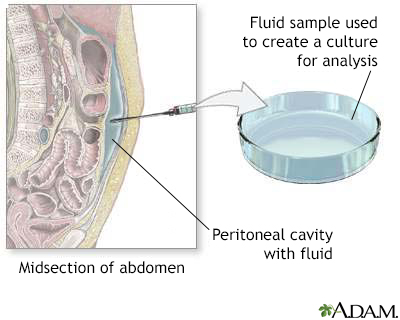
Peritoneal culture
Schedule an Appointment
Definition
Peritoneal fluid culture is a laboratory test performed on a sample of peritoneal fluid. It is done to detect bacteria or fungi that cause infection (peritonitis).
Peritoneal fluid is the fluid in the peritoneal cavity, a space between the wall of the abdomen and the organs inside.
How the Test is Performed
A sample of peritoneal fluid is needed. This sample is obtained using a procedure called an abdominal tap (paracentesis).
A sample of fluid is sent to the laboratory for Gram stain and culture. The sample is checked to see if bacteria grows.
How to Prepare for the Test
Empty your bladder before your abdominal tap procedure.
How the Test will Feel
A small area in your lower abdomen will be cleaned with germ-killing medicine (antiseptic). You may also receive local anesthesia. You will feel pressure as the needle is inserted. If a large amount of fluid is withdrawn, you may feel dizzy or lightheaded.
Why the Test is Performed
The test is done to find out if there is an infection in the peritoneal space.
Normal Results
Peritoneal fluid is a sterile fluid, so normally no bacteria or fungi are present.
What Abnormal Results Mean
The growth of any microorganism, such as bacteria or fungi, from peritoneal fluid is abnormal and indicates peritonitis. If you have cirrhosis and bacteria are found in your peritoneal fluid, you may have spontaneous bacterial peritonitis (SBP). This is a life-threatening infection that must be treated with antibiotics. If your peritonitis is from another condition, your provider will treat it and look for the cause.
Risks
There is a small risk of the needle puncturing the bowel, bladder, or a blood vessel in the abdomen. This may result in bowel perforation, bleeding, and infection.
Considerations
The peritoneal fluid culture may be negative, even if you have peritonitis. The diagnosis of peritonitis is based on other factors, in addition to the culture.
References
Bush LM, Levison ME. Peritonitis and intraperitoneal abscesses. In: Bennett JE, Dolin R, Blaser MJ, eds. Mandell, Douglas, and Bennett's Principles and Practice of Infectious Diseases. 9th ed. Philadelphia, PA: Elsevier; 2020:chap 74.
Solà E, Ginès P. Ascites and spontaneous bacterial peritonitis. In: Feldman M, Friedman LS, Brandt LJ, eds. Sleisenger and Fordtran's Gastrointestinal and Liver Disease. 11th ed. Philadelphia, PA: Elsevier; 2021:chap 93.

Review Date: 10/30/2024
Reviewed By: Jenifer K. Lehrer, MD, Gastroenterologist, Philadelphia, PA. Review provided by VeriMed Healthcare Network. Also reviewed by David C. Dugdale, MD, Medical Director, Brenda Conaway, Editorial Director, and the A.D.A.M. Editorial team.
The information provided herein should not be used during any medical emergency or for the diagnosis or treatment of any medical condition. A licensed medical professional should be consulted for diagnosis and treatment of any and all medical conditions. Links to other sites are provided for information only -- they do not constitute endorsements of those other sites. No warranty of any kind, either expressed or implied, is made as to the accuracy, reliability, timeliness, or correctness of any translations made by a third-party service of the information provided herein into any other language.
© 1997-
A.D.A.M., a business unit of Ebix, Inc. Any duplication or distribution of the information contained herein is strictly prohibited.
All content on this site including text, images, graphics, audio, video, data, metadata, and compilations is protected by copyright and other intellectual property laws. You may view the content for personal, noncommercial use. Any other use requires prior written consent from Ebix. You may not copy, reproduce, distribute, transmit, display, publish, reverse-engineer, adapt, modify, store beyond ordinary browser caching, index, mine, scrape, or create derivative works from this content. You may not use automated tools to access or extract content, including to create embeddings, vectors, datasets, or indexes for retrieval systems. Use of any content for training, fine-tuning, calibrating, testing, evaluating, or improving AI systems of any kind is prohibited without express written consent. This includes large language models, machine learning models, neural networks, generative systems, retrieval-augmented systems, and any software that ingests content to produce outputs. Any unauthorized use of the content including AI-related use is a violation of our rights and may result in legal action, damages, and statutory penalties to the fullest extent permitted by law. Ebix reserves the right to enforce its rights through legal, technological, and contractual measures.
 All rights reserved