
Gastric tissue biopsy and culture

Definition
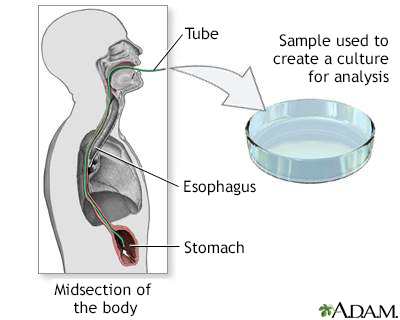
Gastric tissue biopsy is the removal of stomach tissue for examination. A culture is a laboratory test that examines the tissue sample for bacteria and other organisms that can cause disease.
How the Test is Performed
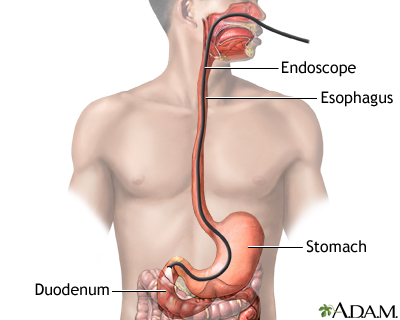
The tissue sample is removed during a procedure called upper endoscopy (or EGD). It is done with a flexible tube with a small camera (flexible endoscope) at the end. The scope is inserted down the throat into the stomach.
Your health care provider sends the tissue sample to a laboratory where it is examined for signs of cancer, certain infections, or other problems.
How to Prepare for the Test
Follow instructions on how to prepare for the procedure. You will likely be asked not to eat or drink anything for 6 to 12 hours before the procedure.
How the Test will Feel
Your provider will tell you what to expect during the procedure.
Why the Test is Performed
This test may be done to diagnose a stomach ulcer or the cause of other stomach symptoms. These symptoms may include:
- Loss of appetite or weight loss
- Nausea and vomiting
- Pain in the upper part of the belly
- Black stools
- Vomiting blood or coffee ground-like material
A gastric tissue biopsy and culture can help detect:
- Cancer
- Infections, most commonly Helicobacter pylori, the bacteria that can cause stomach or intestinal ulcers
Normal Results
A gastric tissue biopsy is normal if it does not show cancer, other damage to the lining of the stomach, or signs of organisms that cause infection.
A gastric tissue culture may be considered normal if it does not show certain bacteria. Stomach acids normally prevent too much bacteria from growing.
What Abnormal Results Mean
Abnormal results may be due to:
- Stomach (gastric) cancer
- Gastritis, when the lining of the stomach becomes inflamed or swollen
- Helicobacter pylori infection
Risks
Your provider will discuss the risks of the upper endoscopy procedure with you.
References
Feldman M, Jensen PJ, Howden CW. Gastritis and gastropathy. In: Feldman M, Friedman LS, Brandt LJ, eds. Sleisenger & Fordtran's Gastrointestinal and Liver Disease. 11th ed. Philadelphia, PA: Elsevier; 2021:chap 52.
Sugumar A, Vargo JJ. Preparation for and complications of GI endoscopy. In: Feldman M, Friedman LS, Brandt LJ, eds. Sleisenger & Fordtran's Gastrointestinal and Liver Disease. 11th ed. Philadelphia, PA: Elsevier; 2021:chap 42.

Review Date: 10/13/2023
Reviewed By: Linda J. Vorvick, MD, Clinical Professor, Department of Family Medicine, UW Medicine, School of Medicine, University of Washington, Seattle, WA. Also reviewed by David C. Dugdale, MD, Medical Director, Brenda Conaway, Editorial Director, and the A.D.A.M. Editorial team.
The information provided herein should not be used during any medical emergency or for the diagnosis or treatment of any medical condition. A licensed medical professional should be consulted for diagnosis and treatment of any and all medical conditions. Links to other sites are provided for information only -- they do not constitute endorsements of those other sites. No warranty of any kind, either expressed or implied, is made as to the accuracy, reliability, timeliness, or correctness of any translations made by a third-party service of the information provided herein into any other language.
© 1997-
A.D.A.M., a business unit of Ebix, Inc. Any duplication or distribution of the information contained herein is strictly prohibited.
All content on this site including text, images, graphics, audio, video, data, metadata, and compilations is protected by copyright and other intellectual property laws. You may view the content for personal, noncommercial use. Any other use requires prior written consent from Ebix. You may not copy, reproduce, distribute, transmit, display, publish, reverse-engineer, adapt, modify, store beyond ordinary browser caching, index, mine, scrape, or create derivative works from this content. You may not use automated tools to access or extract content, including to create embeddings, vectors, datasets, or indexes for retrieval systems. Use of any content for training, fine-tuning, calibrating, testing, evaluating, or improving AI systems of any kind is prohibited without express written consent. This includes large language models, machine learning models, neural networks, generative systems, retrieval-augmented systems, and any software that ingests content to produce outputs. Any unauthorized use of the content including AI-related use is a violation of our rights and may result in legal action, damages, and statutory penalties to the fullest extent permitted by law. Ebix reserves the right to enforce its rights through legal, technological, and contractual measures.
 All rights reserved