
Joint fluid culture

Joint aspiration
Schedule an Appointment
Definition
Joint fluid culture is a laboratory test to detect infection-causing germs in a sample of fluid that is in a joint.
How the Test is Performed
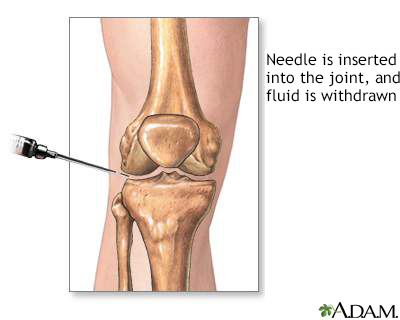
A sample of joint fluid is needed. This may be done in a health care provider's office using a needle, or much less often, during an operating room procedure. Removing the sample is called joint fluid aspiration.
The fluid sample is sent to a lab. There, it is placed in a special dish and watched to see if bacteria or fungi grow. This is called a culture.
If these germs are detected, other tests may be done to further identify the infection-causing substance and its sensitivities or resistance to different antibiotics and determine the best treatment.
How to Prepare for the Test
Your provider will tell you how to prepare for the procedure. No special preparation is needed. But, tell your provider if you're taking a blood thinner, such as aspirin, warfarin (Coumadin) or clopidogrel (Plavix). These medicines can affect test results or your ability to take the test.
How the Test will Feel
After cleansing your skin thoroughly, usually, your provider will first inject numbing medicine into the skin with a small needle, which will sting. A larger needle is then used to draw out the synovial fluid.
This test may also cause some discomfort if the tip of the needle touches bone. The procedure usually lasts less than 1 to 2 minutes.
Why the Test is Performed
Your provider may order this test if you have unexplained pain and inflammation of a joint or a suspected joint infection.
Normal Results
The test result is considered normal if no organisms (bacteria or fungi) grow in the lab dish.
What Abnormal Results Mean
Abnormal results are a sign of infection in the joint. Infections may include:
- Bacterial arthritis
- Fungal arthritis
- Gonococcal arthritis
- Tuberculous arthritis
Risks
Risks of this test include:
- Infection of the joint -- unusual, but more common with repeated aspirations
- Bleeding into the joint space
References
Karcher DS, McPherson RA. Cerebrospinal, synovial, serous body fluids, and alternative specimens. In: McPherson RA, Pincus MR, eds. Henry's Clinical Diagnosis and Management by Laboratory Methods. 24th ed. Philadelphia, PA: Elsevier; 2022:chap 30.
O'Neil L, Tanner S, El-Gabalawy HS. Synovial fluid analyses, synovial biopsy, and synovial pathology. In: Firestein GS, Mclnnes IB, Koretzky GA, Mikuls TR, Neogi T, O'Dell JR, eds. Firestein & Kelly's Textbook of Rheumatology. 12th ed. Philadelphia, PA: Elsevier; 2025:chap 53.

Review Date: 10/27/2024
Reviewed By: Laura J. Martin, MD, MPH, ABIM Board Certified in Internal Medicine and Hospice and Palliative Medicine, Atlanta, GA. Also reviewed by David C. Dugdale, MD, Medical Director, Brenda Conaway, Editorial Director, and the A.D.A.M. Editorial team.
The information provided herein should not be used during any medical emergency or for the diagnosis or treatment of any medical condition. A licensed medical professional should be consulted for diagnosis and treatment of any and all medical conditions. Links to other sites are provided for information only -- they do not constitute endorsements of those other sites. No warranty of any kind, either expressed or implied, is made as to the accuracy, reliability, timeliness, or correctness of any translations made by a third-party service of the information provided herein into any other language.
© 1997-
A.D.A.M., a business unit of Ebix, Inc. Any duplication or distribution of the information contained herein is strictly prohibited.
All content on this site including text, images, graphics, audio, video, data, metadata, and compilations is protected by copyright and other intellectual property laws. You may view the content for personal, noncommercial use. Any other use requires prior written consent from Ebix. You may not copy, reproduce, distribute, transmit, display, publish, reverse-engineer, adapt, modify, store beyond ordinary browser caching, index, mine, scrape, or create derivative works from this content. You may not use automated tools to access or extract content, including to create embeddings, vectors, datasets, or indexes for retrieval systems. Use of any content for training, fine-tuning, calibrating, testing, evaluating, or improving AI systems of any kind is prohibited without express written consent. This includes large language models, machine learning models, neural networks, generative systems, retrieval-augmented systems, and any software that ingests content to produce outputs. Any unauthorized use of the content including AI-related use is a violation of our rights and may result in legal action, damages, and statutory penalties to the fullest extent permitted by law. Ebix reserves the right to enforce its rights through legal, technological, and contractual measures.
 All rights reserved