
Stool ova and parasites exam

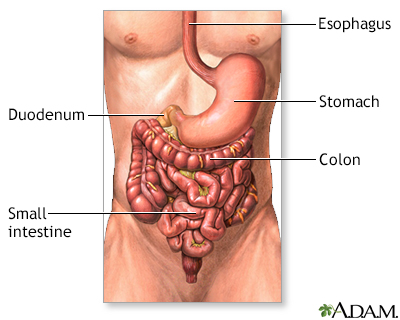
Lower digestive anatomy
Schedule an Appointment
Definition
Stool ova and parasites exam is a lab test to look for parasites or eggs (ova) in a stool sample. The parasites are associated with intestinal infections.
How the Test is Performed
A stool sample is needed.
There are many ways to collect the sample. You can collect the sample:
- On plastic wrap. Place the wrap loosely over the toilet bowl so that it is held in place by the toilet seat. Put the sample in a clean container given to you by your health care provider.
- In a plastic container on the toilet that the lab may give you.
- In a test kit that supplies a special toilet tissue. Put it in a clean container given to you by your provider.
Do not mix urine, water, or toilet tissue with the sample.
For children wearing diapers:
- Line the diaper with plastic wrap.
- Position the plastic wrap so that it will prevent urine and stool from mixing. This will provide a better sample.
Return the sample to your provider's office or lab as directed. At the lab, a small smear of stool is placed on a microscope slide and examined.
How the Test will Feel
The laboratory test does not involve you. There is no discomfort.
Why the Test is Performed
Your provider may order this test if you have signs of parasites, diarrhea that does not go away, or other intestinal symptoms.
To make the test more sensitive to picking up parasites, 3 different stool specimens for ova and parasite testing is recommended.
Other tests, such as molecular tests, may also be used to detect parasites.
Normal Results
There are no parasites or eggs in the stool sample.
Talk to your provider about the meaning of your test results.
What Abnormal Results Mean
An abnormal result means parasites or eggs are present in the stool. This is a sign of parasitic infection, such as:
Risks
There are no risks.
References
Fleckenstein JM. Approach to the patient with suspected enteric infection. In: Goldman L, Cooney KA, eds. Goldman-Cecil Medicine. 27th ed. Philadelphia, PA: Elsevier; 2024:chap 262.
Melia JMP, Sears CL. Infectious enteritis and proctocolitis. In: Feldman M, Friedman LS, Brandt LJ, eds. Sleisenger and Fordtran's Gastrointestinal and Liver Disease. 11th ed. Philadelphia, PA: Elsevier; 2021:chap 110.
Siddiqi HA, Rabinowitz S, Axiotis CA. Laboratory diagnosis of gastrointestinal and pancreatic disorders. In: McPherson RA, Pincus MR, eds. Henry's Clinical Diagnosis and Management by Laboratory Methods. 24th ed. Philadelphia, PA: Elsevier; 2022:chap 23.
Wojewoda CM, Stempak LM. Medical bacteriology. In: McPherson RA, Pincus MR, eds. Henry's Clinical Diagnosis and Management by Laboratory Methods. 24 th ed. Philadelphia, PA: Elsevier; 2022:chap 57.

Review Date: 6/11/2024
Reviewed By: Jenifer K. Lehrer, MD, Department of Gastroenterology, Aria - Jefferson Health Torresdale, Jefferson Digestive Diseases Network, Philadelphia, PA. Review provided by VeriMed Healthcare Network. Also reviewed by David C. Dugdale, MD, Medical Director, Brenda Conaway, Editorial Director, and the A.D.A.M. Editorial team.
The information provided herein should not be used during any medical emergency or for the diagnosis or treatment of any medical condition. A licensed medical professional should be consulted for diagnosis and treatment of any and all medical conditions. Links to other sites are provided for information only -- they do not constitute endorsements of those other sites. No warranty of any kind, either expressed or implied, is made as to the accuracy, reliability, timeliness, or correctness of any translations made by a third-party service of the information provided herein into any other language.
© 1997-
A.D.A.M., a business unit of Ebix, Inc. Any duplication or distribution of the information contained herein is strictly prohibited.
All content on this site including text, images, graphics, audio, video, data, metadata, and compilations is protected by copyright and other intellectual property laws. You may view the content for personal, noncommercial use. Any other use requires prior written consent from Ebix. You may not copy, reproduce, distribute, transmit, display, publish, reverse-engineer, adapt, modify, store beyond ordinary browser caching, index, mine, scrape, or create derivative works from this content. You may not use automated tools to access or extract content, including to create embeddings, vectors, datasets, or indexes for retrieval systems. Use of any content for training, fine-tuning, calibrating, testing, evaluating, or improving AI systems of any kind is prohibited without express written consent. This includes large language models, machine learning models, neural networks, generative systems, retrieval-augmented systems, and any software that ingests content to produce outputs. Any unauthorized use of the content including AI-related use is a violation of our rights and may result in legal action, damages, and statutory penalties to the fullest extent permitted by law. Ebix reserves the right to enforce its rights through legal, technological, and contractual measures.
 All rights reserved