
Skin or nail culture

Definition
A skin or nail culture is a lab test to look for and identify germs that cause problems with the skin or nails.
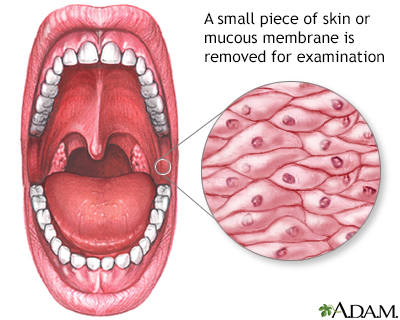
It is called a mucosal culture if the sample involves the mucous membranes.
How the Test is Performed
Your health care provider may use a cotton swab or knife blade to collect a sample from an open skin rash or skin sore.
A sample of skin may need to be taken. This is called a skin biopsy. Before the skin sample is removed, you will likely receive a shot (injection) of numbing medicine to prevent pain.
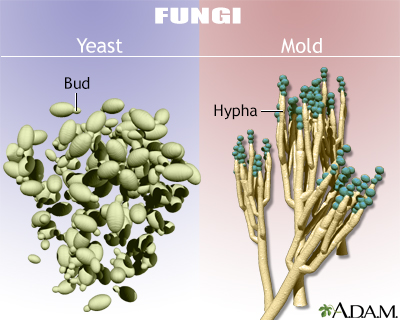
A small sample of a fingernail or toenail may be taken. The sample is sent to a lab. There, it is placed in a special dish (culture). It is then watched to see if bacteria, viruses, or fungi grow. It may take up to 3 weeks to get results of a nail culture. Further tests can be done to identify the specific germ that is causing your problem. This can help your provider determine the best treatment.
How to Prepare for the Test
There is no preparation needed for this test. If a skin or mucosal sample is needed, your provider will tell you how to prepare.
How the Test will Feel
If a skin biopsy is done, you may feel a sting when the shot of numbing medicine is given.
For a nail sample, the provider scrapes the affected area of the nail or clips off a piece of the nail. There is usually no pain.
Why the Test is Performed
This test may be done to diagnose the cause of:
- A bacteria or fungus infection of the skin, finger, or toenail
- A skin rash or sore that appears to be infected
- A skin ulcer that is not healing
Normal Results
A normal result means no disease-causing germs are seen in the culture.
Some germs normally live on the skin. These are not a sign of infection and are considered a normal finding.
Normal value ranges may vary slightly among different labs. Some labs use different measurements or test different samples. Talk to your provider about the meaning of your specific test results.
What Abnormal Results Mean
An abnormal result means bacteria, fungus, or virus is present. This may be a sign of infection.
Common skin infections caused by bacteria include:
Common skin infections caused by fungus include:
- Athlete's foot
- Nail infections
- Ringworm
Risks
Risks include slight bleeding or infection in the area where the skin sample was removed.
References
Dinulos JGH. Dermatologic surgical procedures. In: Dinulos JGH, ed. Habif's Clinical Dermatology. 7th ed. Philadelphia, PA: Elsevier; 2021:chap 27.
Iwen PC, Thompson GR, Wiederhold NP. Mycotic diseases. In: McPherson RA, Pincus MR, eds. Henry's Clinical Diagnosis and Management by Laboratory Methods. 24th ed. Philadelphia, PA: Elsevier; 2022:chap 60.
Wojewoda CM, Stempak LM. Medical bacteriology. In: McPherson RA, Pincus MR, eds. Henry's Clinical Diagnosis and Management by Laboratory Methods. 24th ed. Philadelphia, PA: Elsevier; 2022:chap 57.

Review Date: 7/3/2025
Reviewed By: Linda J. Vorvick, MD, Clinical Professor Emeritus, Department of Family Medicine, UW Medicine, School of Medicine, University of Washington, Seattle, WA. Also reviewed by David C. Dugdale, MD, Medical Director, Brenda Conaway, Editorial Director, and the A.D.A.M. Editorial team.
The information provided herein should not be used during any medical emergency or for the diagnosis or treatment of any medical condition. A licensed medical professional should be consulted for diagnosis and treatment of any and all medical conditions. Links to other sites are provided for information only -- they do not constitute endorsements of those other sites. No warranty of any kind, either expressed or implied, is made as to the accuracy, reliability, timeliness, or correctness of any translations made by a third-party service of the information provided herein into any other language.
© 1997-
A.D.A.M., a business unit of Ebix, Inc. Any duplication or distribution of the information contained herein is strictly prohibited.
All content on this site including text, images, graphics, audio, video, data, metadata, and compilations is protected by copyright and other intellectual property laws. You may view the content for personal, noncommercial use. Any other use requires prior written consent from Ebix. You may not copy, reproduce, distribute, transmit, display, publish, reverse-engineer, adapt, modify, store beyond ordinary browser caching, index, mine, scrape, or create derivative works from this content. You may not use automated tools to access or extract content, including to create embeddings, vectors, datasets, or indexes for retrieval systems. Use of any content for training, fine-tuning, calibrating, testing, evaluating, or improving AI systems of any kind is prohibited without express written consent. This includes large language models, machine learning models, neural networks, generative systems, retrieval-augmented systems, and any software that ingests content to produce outputs. Any unauthorized use of the content including AI-related use is a violation of our rights and may result in legal action, damages, and statutory penalties to the fullest extent permitted by law. Ebix reserves the right to enforce its rights through legal, technological, and contractual measures.
 All rights reserved