
Sputum Gram stain

Sputum test
Schedule an Appointment
Definition
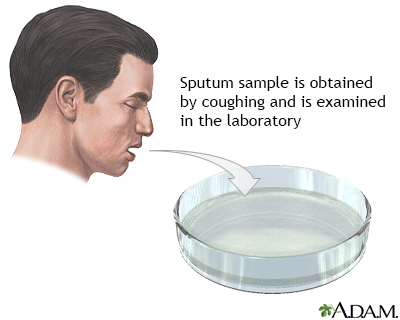
A sputum Gram stain is a lab test used to detect bacteria in a sputum sample. Sputum is the material that comes up from your air passages when you cough very deeply.
The Gram stain method is one of the most commonly used methods to rapidly identify the type of bacteria in a bacterial infection, including pneumonia.
How the Test is Performed
A sputum sample is needed.
- You will be asked to cough deeply and spit any substance that comes up from your lungs (sputum) into a special container.
- You may be asked to breathe in a mist of salty steam. This makes you cough more deeply and produce sputum.
- If you still do not produce enough sputum, you might have a procedure called bronchoscopy.
- To increase the accuracy, this test is sometimes done 3 times, often 3 days in a row.
The sample is sent to a lab. The lab team member places a very thin layer of the sample onto a glass slide. This is called a smear. Stains are placed on the sample. The lab team member looks at the stained slide under a microscope, checking for bacteria and white blood cells. The color, size, and shape of the cells help identify the bacteria.
How to Prepare for the Test
Drinking fluids the night before the test may help your lungs produce phlegm. It makes the test more accurate if it is done first thing in the morning.
If you are having a bronchoscopy, follow your health care provider's instructions on how to prepare for the procedure.
How the Test will Feel
There is no discomfort, unless a bronchoscopy needs to be performed.
Why the Test is Performed
Your provider may order this test if you have a persistent or prolonged cough, or if you are coughing up material that has a foul odor or unusual color. The test may also be done if you have other signs and symptoms of a respiratory disease or an infection.
Normal Results
A normal result means that few to no white blood cells and no bacteria were seen in the sample. The sputum is clear, thin, and odorless.
What Abnormal Results Mean
An abnormal result means that bacteria are seen in the test sample. You may have a bacterial infection. A culture is needed to confirm the diagnosis.
Risks
There are no risks, unless bronchoscopy is performed.
References
Dockrell DH, Ho A, Gordon SB. Community-acquired pneumonia. In: Broaddus VC, Ernst JD, King TE, et al, eds. Murray and Nadel's Textbook of Respiratory Medicine. 7th ed. Philadelphia, PA: Elsevier; 2022:chap 46.
Plourde AR, Beavis KG. Specimen collection and handling for diagnosis of infectious diseases. In: McPherson RA, Pincus MR, eds. Henry's Clinical Diagnosis and Management by Laboratory Methods. 24th ed. Philadelphia, PA: Elsevier; 2022:chap 66.

Review Date: 10/11/2024
Reviewed By: Frank D. Brodkey, MD, FCCM, Associate Professor, Section of Pulmonary and Critical Care Medicine, University of Wisconsin School of Medicine and Public Health, Madison, WI. Also reviewed by David C. Dugdale, MD, Medical Director, Brenda Conaway, Editorial Director, and the A.D.A.M. Editorial team.
The information provided herein should not be used during any medical emergency or for the diagnosis or treatment of any medical condition. A licensed medical professional should be consulted for diagnosis and treatment of any and all medical conditions. Links to other sites are provided for information only -- they do not constitute endorsements of those other sites. No warranty of any kind, either expressed or implied, is made as to the accuracy, reliability, timeliness, or correctness of any translations made by a third-party service of the information provided herein into any other language.
© 1997-
A.D.A.M., a business unit of Ebix, Inc. Any duplication or distribution of the information contained herein is strictly prohibited.
All content on this site including text, images, graphics, audio, video, data, metadata, and compilations is protected by copyright and other intellectual property laws. You may view the content for personal, noncommercial use. Any other use requires prior written consent from Ebix. You may not copy, reproduce, distribute, transmit, display, publish, reverse-engineer, adapt, modify, store beyond ordinary browser caching, index, mine, scrape, or create derivative works from this content. You may not use automated tools to access or extract content, including to create embeddings, vectors, datasets, or indexes for retrieval systems. Use of any content for training, fine-tuning, calibrating, testing, evaluating, or improving AI systems of any kind is prohibited without express written consent. This includes large language models, machine learning models, neural networks, generative systems, retrieval-augmented systems, and any software that ingests content to produce outputs. Any unauthorized use of the content including AI-related use is a violation of our rights and may result in legal action, damages, and statutory penalties to the fullest extent permitted by law. Ebix reserves the right to enforce its rights through legal, technological, and contractual measures.
 All rights reserved