
Fluorescein eye stain

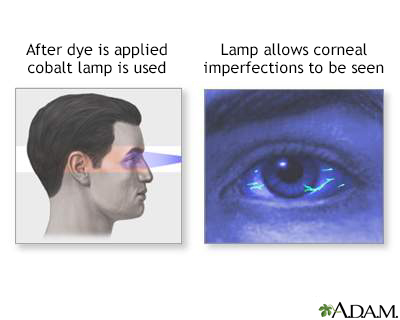
Fluorescent eye test
Schedule an Appointment
Definition
This is a test that uses orange dye (fluorescein) and a blue light to detect foreign bodies in the eye. This test can also detect damage to the cornea. The cornea is the outer surface of the eye.
How the Test is Performed
A piece of blotting paper containing the dye is touched to the surface of your eye. Sometimes the dye comes in a drop form which also contains anesthetic. You are asked to blink. Blinking spreads the dye and coats the tear film covering the surface of the cornea. The tear film contains water, oil, and mucus to protect and lubricate the eye.
The health care provider then shines a blue light at your eye. Any problems on the surface of the cornea will be stained by the dye and appear green under the blue light.
The provider can determine the location and likely cause of the cornea problem depending on the size, location, and shape of the staining.
How to Prepare for the Test
You will need to remove your eyeglasses or contact lenses before the test.
How the Test will Feel
If your eyes are very dry, the blotting paper may be slightly scratchy. The dye may cause a mild and brief stinging sensation if there is no anesthetic used.
Why the Test is Performed
This test is to:
- Find scratches or other problems with the surface of the cornea
- Reveal foreign bodies on the eye surface
- Determine if there is irritation of the cornea after contacts are prescribed
Normal Results
If the test result is normal, the dye remains in the tear film on the surface of the eye but does not show any abnormal areas.
What Abnormal Results Mean
Abnormal results may point to:
- Abnormal tear production (dry eye)
- Blocked tear duct
- Corneal abrasion (a scratch on the surface of the cornea)
- Foreign bodies, such as eyelashes or dust (foreign object in eye)
- Infection
- Injury or trauma
- Severe dry eye associated with arthritis (keratoconjunctivitis sicca)
Often the test is done to check for any of the conditions listed above.
Risks
If the dye touches the skin, there may be a slight, brief, discoloration. It may stain your clothing or other fabric.
References
Fowler GC. Corneal abrasions and removal of corneal or conjunctival foreign bodies. In: Fowler GC, ed. Pfenninger and Fowler's Procedures for Primary Care. 4th ed. Philadelphia, PA: Elsevier; 2020:chap 200.
Knoop KJ, Dennis WR. Ophthalmologic procedures. In: Roberts JR, Custalow CB, Thomsen TW, eds. Roberts and Hedges' Clinical Procedures in Emergency Medicine and Acute Care. 7th ed. Philadelphia, PA: Elsevier; 2019:chap 62.
Sall K, Foulks GN, Pucker AD, Ice KL, Zink RC, Magrath G. Validation of a modified national eye institute grading scale for corneal fluorescein staining. Clin Ophthalmol. 2023;17:757-767. PMID: 36915716 pubmed.ncbi.nlm.nih.gov/36915716/.

Review Date: 1/20/2025
Reviewed By: Franklin W. Lusby, MD, Ophthalmologist, Lusby Vision Institute, La Jolla, CA. Also reviewed by David C. Dugdale, MD, Medical Director, Brenda Conaway, Editorial Director, and the A.D.A.M. Editorial team.
The information provided herein should not be used during any medical emergency or for the diagnosis or treatment of any medical condition. A licensed medical professional should be consulted for diagnosis and treatment of any and all medical conditions. Links to other sites are provided for information only -- they do not constitute endorsements of those other sites. No warranty of any kind, either expressed or implied, is made as to the accuracy, reliability, timeliness, or correctness of any translations made by a third-party service of the information provided herein into any other language.
© 1997-
A.D.A.M., a business unit of Ebix, Inc. Any duplication or distribution of the information contained herein is strictly prohibited.
All content on this site including text, images, graphics, audio, video, data, metadata, and compilations is protected by copyright and other intellectual property laws. You may view the content for personal, noncommercial use. Any other use requires prior written consent from Ebix. You may not copy, reproduce, distribute, transmit, display, publish, reverse-engineer, adapt, modify, store beyond ordinary browser caching, index, mine, scrape, or create derivative works from this content. You may not use automated tools to access or extract content, including to create embeddings, vectors, datasets, or indexes for retrieval systems. Use of any content for training, fine-tuning, calibrating, testing, evaluating, or improving AI systems of any kind is prohibited without express written consent. This includes large language models, machine learning models, neural networks, generative systems, retrieval-augmented systems, and any software that ingests content to produce outputs. Any unauthorized use of the content including AI-related use is a violation of our rights and may result in legal action, damages, and statutory penalties to the fullest extent permitted by law. Ebix reserves the right to enforce its rights through legal, technological, and contractual measures.
 All rights reserved