
Bone lesion biopsy

Definition
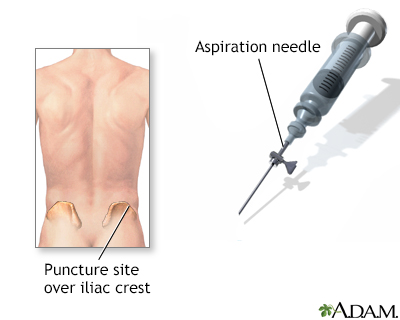
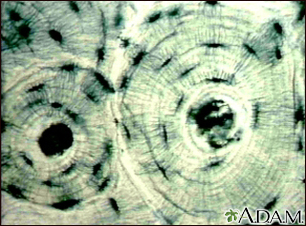
A bone lesion biopsy is the removal of a piece of bone or bone marrow for examination.
How the Test is Performed
The test is done in the following way:
- An x-ray, CT or MRI scan is likely used to guide the exact placement of the biopsy instrument.
- Your surgeon applies a numbing medicine (local anesthetic) to the area.
- A small cut is then made in the skin.
- A special drill needle is often used. This needle is gently inserted through the cut, then pushed and twisted into the bone.
- Once the sample is obtained, the needle is twisted out.
- Pressure is applied to the site. Once bleeding stops, stitches are applied, and covered with a bandage.
- The sample is sent to a lab for examination.
Bone biopsy may also be done under general anesthesia to remove a larger sample. Then surgery to remove the bone can be done if the biopsy exam shows that there is an abnormal growth or cancer.
How to Prepare for the Test
Follow your surgeon's instructions on how to prepare. This may include not eating and drinking for several hours before the procedure. If you take any blood thinners, please make sure you stop them ahead of the procedure.
How the Test will Feel
With a needle biopsy, you may feel some discomfort and pressure, even though a local anesthetic is used. You must remain still during the procedure.
After the biopsy, the area may be sore or tender for several days.
Why the Test is Performed
The most common reasons for bone lesion biopsy are to tell the difference between cancerous and noncancerous bone tumors and to identify other bone or bone marrow problems. It may be performed on people with bone pain and tenderness, particularly if x-ray, CT scan, or other testing reveals a problem.
Normal Results
No abnormal bone tissue is found.
What Abnormal Results Mean
An abnormal result may be any of the following problems.
Benign (noncancerous) bone tumors, such as:
- Bone cyst
- Fibroma
- Osteoblastoma
- Osteoid osteoma
Cancerous tumors, such as:
- Ewing sarcoma
- Multiple myeloma
- Osteosarcoma
- Other types of cancer that may have spread to the bone
Abnormal results may also be due to:
- Osteitis fibrosa (weak and deformed bone)
- Osteomalacia (softening of the bones)
- Osteomyelitis (bone infection)
- Bone marrow disorders (leukemia or lymphoma)
Risks
Risks of this procedure may include:
- Bone fracture
- Bone infection (osteomyelitis)
- Damage to surrounding tissue
- Discomfort
- Excessive bleeding
- Infection near the biopsy area
A serious risk of this procedure is bone infection. Signs of a bone infection include:
- Fever
- Chills
- Worsening pain
- Redness and swelling of around the biopsy site
- Drainage of pus from the biopsy site
- Difficulty with walking or using your limb
If you have any of these signs, contact your health care provider or surgeon right away.
People with bone disorders who also have blood clotting disorders may have an increased risk of bleeding.
References
Jayaram PR, Yan YY, Mallinson PI, Ouellette HA, Munk PL. Interventional radiologic techniques in the management of bone tumors. In: Heymann D, ed. Bone Cancer. 3rd ed. Philadelphia, PA: Elsevier; 2022:chap 55.
Katsanos K, Sabharwal T, Cazzato RL, Gangi A. Skeletal interventions. In: Adam A, Dixon AK, Gillard JH, Schaefer-Prokop CM, eds. Grainger & Allison's Diagnostic Radiology. 7th ed. Philadelphia, PA: Elsevier; 2021:chap 87.
Schwartz HS, Holt GE, Halpern JL. Bone tumors. In: Townsend CM Jr, Beauchamp RD, Evers BM, Mattox KL, eds. Sabiston Textbook of Surgery. 21st ed. St. Louis, MO: Elsevier; 2022:chap 33.

Review Date: 8/27/2024
Reviewed By: C. Benjamin Ma, MD, Professor, Chief, Sports Medicine and Shoulder Service, UCSF Department of Orthopaedic Surgery, San Francisco, CA. Also reviewed by David C. Dugdale, MD, Medical Director, Brenda Conaway, Editorial Director, and the A.D.A.M. Editorial team.
The information provided herein should not be used during any medical emergency or for the diagnosis or treatment of any medical condition. A licensed medical professional should be consulted for diagnosis and treatment of any and all medical conditions. Links to other sites are provided for information only -- they do not constitute endorsements of those other sites. No warranty of any kind, either expressed or implied, is made as to the accuracy, reliability, timeliness, or correctness of any translations made by a third-party service of the information provided herein into any other language.
© 1997-
A.D.A.M., a business unit of Ebix, Inc. Any duplication or distribution of the information contained herein is strictly prohibited.
All content on this site including text, images, graphics, audio, video, data, metadata, and compilations is protected by copyright and other intellectual property laws. You may view the content for personal, noncommercial use. Any other use requires prior written consent from Ebix. You may not copy, reproduce, distribute, transmit, display, publish, reverse-engineer, adapt, modify, store beyond ordinary browser caching, index, mine, scrape, or create derivative works from this content. You may not use automated tools to access or extract content, including to create embeddings, vectors, datasets, or indexes for retrieval systems. Use of any content for training, fine-tuning, calibrating, testing, evaluating, or improving AI systems of any kind is prohibited without express written consent. This includes large language models, machine learning models, neural networks, generative systems, retrieval-augmented systems, and any software that ingests content to produce outputs. Any unauthorized use of the content including AI-related use is a violation of our rights and may result in legal action, damages, and statutory penalties to the fullest extent permitted by law. Ebix reserves the right to enforce its rights through legal, technological, and contractual measures.
 All rights reserved