
Feeding tube - infants

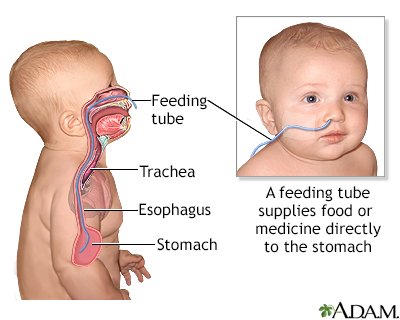
Feeding tube
Schedule an Appointment
Information
A feeding tube is a small, soft, plastic tube placed through the nose (NG) or mouth (OG) into the stomach. These tubes are used to provide feedings and medicines into the stomach until the baby can take food by mouth.
WHY IS A FEEDING TUBE USED?
Feeding from the breast or bottle requires strength and coordination. Sick or premature babies may not be able to suck or swallow well enough to bottle or breastfeed. Tube feedings allow the baby to get some or all of their feeding into the stomach. This is the most efficient and safest way to provide good nutrition. Oral medicines can also be given through the tube.
HOW IS A FEEDING TUBE PLACED?
A feeding tube is gently placed through the nose or mouth into the stomach. An x-ray can confirm correct placement. In babies with feeding problems, the tip of the tube may be placed past the stomach into the small intestine. This provides slower, continuous feedings.
WHAT ARE THE RISKS OF A FEEDING TUBE?
Feeding tubes are generally very safe and effective. However, problems may occur, even when the tube is placed properly. These include:
- Irritation of the nose, mouth, or stomach, causing minor bleeding
- Stuffy nose or infection of the nose if the tube is placed through the nose
If the tube is misplaced and not in the proper position, the baby may have problems with:
- An abnormally slow heart rate (bradycardia)
- Breathing
- Spitting up
In rare cases, the feeding tube can puncture the stomach.
References
George DE, Ogholikhan S. Tubes for enteric access. In: Wyllie R, Hyams JS, Kay M, eds. Pediatric Gastrointestinal and Liver Disease. 6th ed. Philadelphia, PA: Elsevier; 2021:chap 87.
Poindexter BB, Martin CR. Nutritional support for the preterm infant. In: Martin RJ, Fanaroff AA, eds. Fanaroff and Martin's Neonatal-Perinatal Medicine. 12th ed. Philadelphia, PA: Elsevier; 2025:chap 42.

Review Date: 4/1/2024
Reviewed By: Charles I. Schwartz, MD, FAAP, Clinical Assistant Professor of Pediatrics, Perelman School of Medicine at the University of Pennsylvania, General Pediatrician at PennCare for Kids, Phoenixville, PA. Also reviewed by David C. Dugdale, MD, Medical Director, Brenda Conaway, Editorial Director, and the A.D.A.M. Editorial team.
The information provided herein should not be used during any medical emergency or for the diagnosis or treatment of any medical condition. A licensed medical professional should be consulted for diagnosis and treatment of any and all medical conditions. Links to other sites are provided for information only -- they do not constitute endorsements of those other sites. No warranty of any kind, either expressed or implied, is made as to the accuracy, reliability, timeliness, or correctness of any translations made by a third-party service of the information provided herein into any other language.
© 1997-
A.D.A.M., a business unit of Ebix, Inc. Any duplication or distribution of the information contained herein is strictly prohibited.
All content on this site including text, images, graphics, audio, video, data, metadata, and compilations is protected by copyright and other intellectual property laws. You may view the content for personal, noncommercial use. Any other use requires prior written consent from Ebix. You may not copy, reproduce, distribute, transmit, display, publish, reverse-engineer, adapt, modify, store beyond ordinary browser caching, index, mine, scrape, or create derivative works from this content. You may not use automated tools to access or extract content, including to create embeddings, vectors, datasets, or indexes for retrieval systems. Use of any content for training, fine-tuning, calibrating, testing, evaluating, or improving AI systems of any kind is prohibited without express written consent. This includes large language models, machine learning models, neural networks, generative systems, retrieval-augmented systems, and any software that ingests content to produce outputs. Any unauthorized use of the content including AI-related use is a violation of our rights and may result in legal action, damages, and statutory penalties to the fullest extent permitted by law. Ebix reserves the right to enforce its rights through legal, technological, and contractual measures.
 All rights reserved