Morton neuroma
Morton neuralgia; Morton toe syndrome; Morton entrapment; Metatarsal neuralgia; Plantar neuralgia; Intermetatarsal neuralgia; Interdigital neuroma; Interdigital plantar neuroma; Forefoot neuroma; Morton's neuroma
Morton neuroma is an injury to the nerve between the toes that causes thickening and pain. It commonly affects the nerve that travels between the 3rd and 4th toes.
Images
Causes
The exact cause is unknown. Health care providers believe the following may play a role in the development of this condition:
- Wearing tight shoes and high heels
- Abnormal positioning of toes
- Flat feet
- Forefoot problems, including bunions and hammer toes
- High foot arches
Morton neuroma is more common in women than in men.
Symptoms
Symptoms may include:
- Numbness and tingling in the space between the 3rd and 4th toes
- Toe cramping
- Sharp, shooting, or burning pain in the ball of the foot and sometimes toes
- Pain that increases when wearing tight shoes, high heels, or pressing on the area
- Pain that gets worse over time
In rare cases, nerve pain occurs in the space between the 2nd and 3rd toes. This is not a common form of Morton neuroma, but symptoms and treatment are similar.
Exams and Tests
Your provider can usually diagnose this problem by examining your foot. Squeezing your forefoot or toes together bring on the symptoms.
A foot x-ray may be done to check for bone problems. MRI or ultrasound can successfully diagnose the condition.
Nerve testing (electromyography) cannot diagnose Morton neuroma. But it may be used to check for other conditions that cause similar symptoms.
Blood tests may be done to check for inflammation-related conditions, including certain forms of arthritis.
Treatment
Nonsurgical treatment is tried first. Your provider may recommend any of the following:
- Padding and taping the toe area
- Shoe inserts (orthotics)
- Changes to footwear, such as wearing shoes with wider toe boxes or flat heels
- Anti-inflammatory medicines taken by mouth or injected into the area between the toes
- Nerve blocking medicines injected into the toe area
- Other painkillers
- Physical therapy
Anti-inflammatories and painkillers are not recommended for long-term treatment.
In some cases, surgery is needed to remove the thickened tissue and inflamed nerve. This helps relieve pain and improve foot function. Numbness after surgery is permanent.
Outlook (Prognosis)
Nonsurgical treatment does not always improve symptoms. Surgery to remove the thickened tissue is successful in most cases.
Possible Complications
Complications may include:
- Difficulty walking
- Trouble with activities that put pressure on the foot, such as pressing the gas pedal while driving
- Difficulty wearing certain types of shoes, such as high-heels
When to Contact a Medical Professional
Contact your provider if you have constant pain or tingling in your foot or toe area.
Prevention
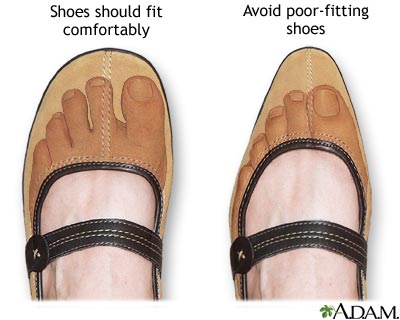
Avoid ill-fitting shoes. Wear shoes with a wide toe box or lower heels.
Related Information
Foot painReferences
Grear BJ. Neurogenic disorders. In: Azar FM, Beaty JH, eds. Campbell's Operative Orthopaedics. 14th ed. Philadelphia, PA: Elsevier; 2021:chap 87.
Shi GG. Morton's neuroma. In: Frontera WR, Silver JK, Rizzo TD Jr, eds. Essentials of Physical Medicine and Rehabilitation: Musculoskeletal Disorders, Pain, and Rehabilitation. 4th ed. Philadelphia, PA: Elsevier; 2019:chap 91.
BACK TO TOPReview Date: 6/4/2025
Reviewed By: C. Benjamin Ma, MD, Professor, Chief, Sports Medicine and Shoulder Service, UCSF Department of Orthopaedic Surgery, San Francisco, CA. Also reviewed by David C. Dugdale, MD, Medical Director, Brenda Conaway, Editorial Director, and the A.D.A.M. Editorial team.

Health Content Provider
06/01/2028
|
A.D.A.M., Inc. is certified by URAC, for Health Content Provider (www.urac.org). URAC's certification program is an independent audit to verify that A.D.A.M. follows rigorous standards of quality and accountability. A.D.A.M. is among the first to achieve this important distinction for online health information and services. Learn more about A.D.A.M.'s editorial policy, editorial process and privacy policy. |
The information provided herein should not be used during any medical emergency or for the diagnosis or treatment of any medical condition. A licensed medical professional should be consulted for diagnosis and treatment of any and all medical conditions. Links to other sites are provided for information only -- they do not constitute endorsements of those other sites. No warranty of any kind, either expressed or implied, is made as to the accuracy, reliability, timeliness, or correctness of any translations made by a third-party service of the information provided herein into any other language.
© 1997-
2026 A.D.A.M., a business unit of Ebix, Inc. Any duplication or distribution of the information contained herein is strictly prohibited.
All content on this site including text, images, graphics, audio, video, data, metadata, and compilations is protected by copyright and other intellectual property laws. You may view the content for personal, noncommercial use. Any other use requires prior written consent from Ebix. You may not copy, reproduce, distribute, transmit, display, publish, reverse-engineer, adapt, modify, store beyond ordinary browser caching, index, mine, scrape, or create derivative works from this content. You may not use automated tools to access or extract content, including to create embeddings, vectors, datasets, or indexes for retrieval systems. Use of any content for training, fine-tuning, calibrating, testing, evaluating, or improving AI systems of any kind is prohibited without express written consent. This includes large language models, machine learning models, neural networks, generative systems, retrieval-augmented systems, and any software that ingests content to produce outputs. Any unauthorized use of the content including AI-related use is a violation of our rights and may result in legal action, damages, and statutory penalties to the fullest extent permitted by law. Ebix reserves the right to enforce its rights through legal, technological, and contractual measures.
 All rights reserved.