
Limb plethysmography

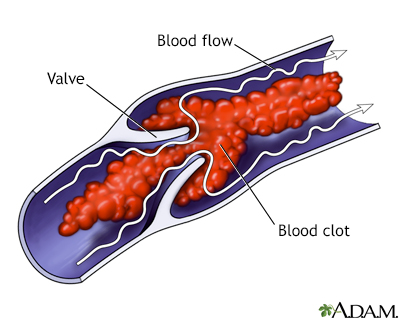
Venous blood clot
Schedule an Appointment
Definition
Limb plethysmography is a test that compares blood pressure in the legs and arms.
How the Test is Performed
This test may be done in the health care provider's office or in a hospital. You will be asked to lie with the upper part of your body slightly raised.
Three or four blood pressure cuffs are wrapped snugly around your arm and leg. The provider inflates the cuffs, and a machine called a plethysmograph measures the pulses from each cuff. The test records the maximum pressure produced when the heart contracts (systolic blood pressure).
Differences between the pulses are noted. If there is a decrease in the pulse between the arm and leg, it may indicate a blockage.
When the test is complete, the blood pressure cuffs are removed.
How to Prepare for the Test
Do not smoke for at least 30 minutes before the test. You will be asked to remove all clothing from the arm and leg being tested.
How the Test will Feel
You should not have much discomfort with this test. You should only feel the pressure of the blood pressure cuff. The test often takes less than 20 to 30 minutes to perform.
Why the Test is Performed
This test is most often done to check for narrowing or blockages of blood vessels (arteries) in the arms or legs.
Normal Results
There should be less than a 20 to 30 mm Hg difference in the systolic blood pressure of the leg compared with that of the arm.
What Abnormal Results Mean
Abnormal results may be due to:
- Arterial occlusive disease
- Blood clots
- Blood vessel changes due to diabetes
- Injury to an artery
- Other blood vessel disease (vascular disease)
Other conditions for which the test may be performed:
If you have an abnormal result, you may need to have more testing to find the exact site of the narrowing.
Risks
There are no risks.
Considerations
This test is not as accurate as an arteriography. Plethysmography may be done for very ill people who cannot travel to the arteriography lab. This test can be used to check for vascular disease or to follow up earlier abnormal tests.
The test is noninvasive, and it does not use x-rays or injection of dye. It is also less expensive than an angiogram.
References
Bonaca MP, Creager MA. Peripheral artery diseases. In: Libby, P, Bonow RO, Mann DL, Tomaselli, GF, Bhatt DL, Solomon SD. Braunwald's Heart Disease: A Textbook of Cardiovascular Medicine. 12th ed. Philadelphia, PA: Elsevier; 2022:chap 43.
Recht MH, Muck PE. Vascular laboratory: arterial physiologic assessment. In: Sidawy AN, Perler BA, eds. Rutherford’s Vascular Surgery and Endovascular Therapy. 10th ed. Philadelphia, PA: Elsevier; 2023:chap 21.

Review Date: 5/10/2024
Reviewed By: Neil Grossman, MD, Saint Vincent Radiological Associates, Framingham, MA. Review provided by VeriMed Healthcare Network. Also reviewed by David C. Dugdale, MD, Medical Director, Brenda Conaway, Editorial Director, and the A.D.A.M. Editorial team.
The information provided herein should not be used during any medical emergency or for the diagnosis or treatment of any medical condition. A licensed medical professional should be consulted for diagnosis and treatment of any and all medical conditions. Links to other sites are provided for information only -- they do not constitute endorsements of those other sites. No warranty of any kind, either expressed or implied, is made as to the accuracy, reliability, timeliness, or correctness of any translations made by a third-party service of the information provided herein into any other language.
© 1997-
A.D.A.M., a business unit of Ebix, Inc. Any duplication or distribution of the information contained herein is strictly prohibited.
All content on this site including text, images, graphics, audio, video, data, metadata, and compilations is protected by copyright and other intellectual property laws. You may view the content for personal, noncommercial use. Any other use requires prior written consent from Ebix. You may not copy, reproduce, distribute, transmit, display, publish, reverse-engineer, adapt, modify, store beyond ordinary browser caching, index, mine, scrape, or create derivative works from this content. You may not use automated tools to access or extract content, including to create embeddings, vectors, datasets, or indexes for retrieval systems. Use of any content for training, fine-tuning, calibrating, testing, evaluating, or improving AI systems of any kind is prohibited without express written consent. This includes large language models, machine learning models, neural networks, generative systems, retrieval-augmented systems, and any software that ingests content to produce outputs. Any unauthorized use of the content including AI-related use is a violation of our rights and may result in legal action, damages, and statutory penalties to the fullest extent permitted by law. Ebix reserves the right to enforce its rights through legal, technological, and contractual measures.
 All rights reserved