
Breast cancer in men

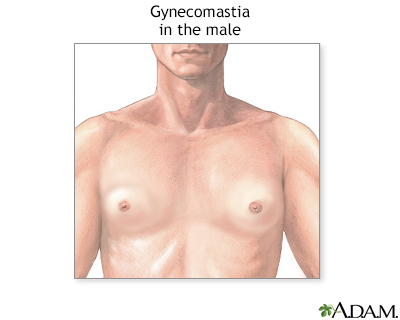
Gynecomastia
Schedule an Appointment
Definition
Breast cancer is cancer that starts in breast tissue. Both males and females have breast tissue. This means that anyone, including men and boys, can develop breast cancer.
Breast cancer in men is rare. Male breast cancer accounts for less than 1% of all breast cancers.
Causes
The cause of breast cancer in men is not clear. But there are risk factors that make breast cancer more likely in men:
- Exposure to radiation
- Higher estrogen levels due to factors such as heavy alcohol use, cirrhosis, and obesity
- Heredity, such as a family history of breast cancer, having a variant BRCA1 or BRCA2 gene, and certain genetic disorders, such as Klinefelter syndrome
- Excess breast tissue (gynecomastia)
- Older age -- men are often diagnosed with breast cancer between ages 60 and 70
Symptoms
Symptoms of breast cancer in men include:
- Lump or swelling in the breast tissue. One breast may be larger than the other.
- A small lump beneath the nipple.
- Unusual changes in the nipple or skin around the nipple such as redness, scaling, or puckering.
- Nipple discharge.
Exams and Tests
Your health care provider will take your medical history and family medical history. You will have a physical exam and a breast exam.
Your provider may order other tests, including:
- A mammogram.
- Breast ultrasound.
- An MRI of the breast.
- If any of the tests suggest cancer, your provider will arrange a biopsy to check for cancer.
If cancer is found, your provider will order other tests to find out:
- How it has spread
- What treatments might be best
- What are the chances that the cancer might come back
The tests may include:
- Bone scan
- CT scan
- PET scan
- Sentinel lymph node biopsy to check if the cancer has spread to the lymph nodes
The biopsy and other tests will be used to grade and stage the tumor. The results of those tests will help determine your treatment.
Treatment
Treatment options for breast cancer in men include:
- Surgery to remove the breast, lymph nodes under the arm, the lining over chest muscles, and chest muscles, if needed
- Radiation therapy after surgery to kill any remaining cancer cells and to target specific tumors
- Chemotherapy to kill cancer cells that have spread to other parts of the body or to lower the risk of the cancer returning after surgery
- Hormone therapy to block hormones that may help certain types of breast cancer grow
During and after treatment, your provider may ask you to have more tests. This may include a repeat of tests you had to make the diagnosis.
Support Groups
Cancer affects how you feel about yourself and your life. You can ease the stress of illness by joining a cancer support group. Sharing with others who have had the same experiences and problems can help you feel less alone. The group can also point you to helpful resources for managing your condition.
Ask your provider to help you find a support group of men who have been diagnosed with breast cancer.
Outlook (Prognosis)
The long-term outlook for men with breast cancer is excellent when the cancer is found and treated early.
- About 91% of men treated before the cancer has spread to other areas of the body are cancer-free after 5 years.
- Almost 3 out of 4 men treated for cancer that has spread to lymph nodes but not to other areas of the body are cancer-free at 5 years.
- Men who have cancer that has spread to distant parts of the body have a smaller chance of long-term survival.
Possible Complications
Complications include side effects from surgery, radiation, and chemotherapy.
When to Contact a Medical Professional
Contact your provider right away if you notice something unusual about your breast, including any lumps, skin changes, or discharge.
Prevention
There is no clear way to prevent breast cancer in men. The best way to protect yourself is to:
- Know that men can develop breast cancer
- Know your risk factors and talk with your provider about screening and early detection with tests if needed
- Know the possible signs of breast cancer
- Tell your provider if you notice any changes in your breast
References
Farr DE, Gradishar WJ. Male breast cancer. In: Klimberg VS, Gradishar WJ, Bland KI, Korourian S, White J, Copeland EM, eds. Bland and Copeland's The Breast. 6th ed. Philadelphia, PA: Elsevier; 2024:chap 67.
Kimberg VS, Hunt KL. Diseases of the breast. In: Townsend CM Jr, Beauchamp RD, Evers BM, Mattox KL, eds. Sabiston Textbook of Surgery. 21st ed. St Louis, MO: Elsevier; 2022:chap 35.
National Cancer Institute website. Male breast cancer treatment (PDQ) - health professional version. www.cancer.gov/types/breast/hp/male-breast-treatment-pdq. Updated January 31, 2024. Accessed August 28, 2024.

Review Date: 8/21/2024
Reviewed By: Warren Brenner, MD, Oncologist, Lynn Cancer Institute, Boca Raton, FL. Review provided by VeriMed Healthcare Network. Also reviewed by David C. Dugdale, MD, Medical Director, Brenda Conaway, Editorial Director, and the A.D.A.M. Editorial team.
The information provided herein should not be used during any medical emergency or for the diagnosis or treatment of any medical condition. A licensed medical professional should be consulted for diagnosis and treatment of any and all medical conditions. Links to other sites are provided for information only -- they do not constitute endorsements of those other sites. No warranty of any kind, either expressed or implied, is made as to the accuracy, reliability, timeliness, or correctness of any translations made by a third-party service of the information provided herein into any other language.
© 1997-
A.D.A.M., a business unit of Ebix, Inc. Any duplication or distribution of the information contained herein is strictly prohibited.
All content on this site including text, images, graphics, audio, video, data, metadata, and compilations is protected by copyright and other intellectual property laws. You may view the content for personal, noncommercial use. Any other use requires prior written consent from Ebix. You may not copy, reproduce, distribute, transmit, display, publish, reverse-engineer, adapt, modify, store beyond ordinary browser caching, index, mine, scrape, or create derivative works from this content. You may not use automated tools to access or extract content, including to create embeddings, vectors, datasets, or indexes for retrieval systems. Use of any content for training, fine-tuning, calibrating, testing, evaluating, or improving AI systems of any kind is prohibited without express written consent. This includes large language models, machine learning models, neural networks, generative systems, retrieval-augmented systems, and any software that ingests content to produce outputs. Any unauthorized use of the content including AI-related use is a violation of our rights and may result in legal action, damages, and statutory penalties to the fullest extent permitted by law. Ebix reserves the right to enforce its rights through legal, technological, and contractual measures.
 All rights reserved