
Epley maneuver

Vertigo
Schedule an Appointment
Definition
The Epley maneuver is a series of head movements to relieve symptoms of benign positional vertigo. Benign positional vertigo is also called benign paroxysmal positional vertigo (BPPV). BPPV is caused by a problem in the inner ear. Vertigo is the feeling that you are spinning or that everything is spinning around you.
Description
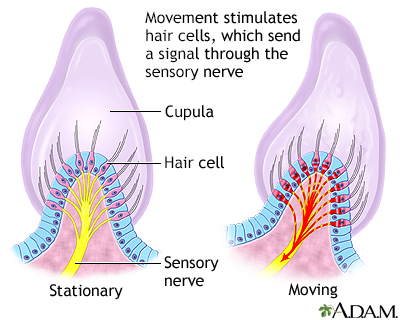
BPPV occurs when small pieces of bone-like calcium (canaliths) break free and float inside small canals in your inner ear. This sends confusing messages to your brain about your body's position, which causes vertigo.
The Epley maneuver is used to move the canaliths out of the canals so they stop causing symptoms.
To perform the maneuver, your health care provider will:
- Turn your head toward the side that causes vertigo.
- Quickly lay you down on your back with your head in the same position just off the edge of the table. You will likely feel more intense vertigo symptoms at this point.
- Slowly move your head to the opposite side.
- Turn your body so that it is in line with your head. You will be lying on your side with your head and body facing to the side.
- Sit you upright.
Your provider may need to repeat these steps a few times.
Why the Procedure Is Performed
Your provider will use this procedure to reposition the canaliths to treat BPPV.
Risks
During the procedure, you may experience:
- Intense vertigo symptoms
- Nausea
- Vomiting (less common)
In a few people, the canaliths may move into another canal in the inner ear and continue to cause vertigo.
Before the Procedure
Tell your provider about any medical conditions that you may have. The procedure may not be a good choice if you have had recent neck or spine problems or a detached retina.
For severe vertigo, your provider may give you medicines to reduce nausea or anxiety before starting the procedure.
After the Procedure
The Epley maneuver often works quickly. For the rest of the day, avoid bending over. For several days after treatment, avoid sleeping on the side that triggers symptoms.
Outlook (Prognosis)
Most of the time, treatment will cure BPPV. Sometimes, vertigo may return after a few weeks. About half the time, BPPV will come back. If this happens, you'll need to be treated again. Your provider may teach you how to perform the maneuver at home.
Your provider may prescribe medicines that can help relieve spinning sensations. However, these medicines often do not work well for treating vertigo.
References
Chang TP, Zee DS, Kheradmand A. Technological advances in testing the dizzy patient: the bedside examination is still the key to successful diagnosis. In: Gleason AT, Kesser BW, eds. Dizziness and Vertigo Across the Lifespan. St Louis, MO: Elsevier; 2018:chap 2.
Crane BT, Minor LB. Peripheral vestibular disorders. In: Flint PW, Francis HW, Haughey BH, et al, eds. Cummings Otolaryngology: Head and Neck Surgery. 7th ed. Philadelphia, PA: Elsevier; 2021:chap 167.

Review Date: 9/10/2023
Reviewed By: Josef Shargorodsky, MD, MPH, Johns Hopkins University School of Medicine, Baltimore, MD. Also reviewed by David C. Dugdale, MD, Medical Director, Brenda Conaway, Editorial Director, and the A.D.A.M. Editorial team.
The information provided herein should not be used during any medical emergency or for the diagnosis or treatment of any medical condition. A licensed medical professional should be consulted for diagnosis and treatment of any and all medical conditions. Links to other sites are provided for information only -- they do not constitute endorsements of those other sites. No warranty of any kind, either expressed or implied, is made as to the accuracy, reliability, timeliness, or correctness of any translations made by a third-party service of the information provided herein into any other language.
© 1997-
A.D.A.M., a business unit of Ebix, Inc. Any duplication or distribution of the information contained herein is strictly prohibited.
All content on this site including text, images, graphics, audio, video, data, metadata, and compilations is protected by copyright and other intellectual property laws. You may view the content for personal, noncommercial use. Any other use requires prior written consent from Ebix. You may not copy, reproduce, distribute, transmit, display, publish, reverse-engineer, adapt, modify, store beyond ordinary browser caching, index, mine, scrape, or create derivative works from this content. You may not use automated tools to access or extract content, including to create embeddings, vectors, datasets, or indexes for retrieval systems. Use of any content for training, fine-tuning, calibrating, testing, evaluating, or improving AI systems of any kind is prohibited without express written consent. This includes large language models, machine learning models, neural networks, generative systems, retrieval-augmented systems, and any software that ingests content to produce outputs. Any unauthorized use of the content including AI-related use is a violation of our rights and may result in legal action, damages, and statutory penalties to the fullest extent permitted by law. Ebix reserves the right to enforce its rights through legal, technological, and contractual measures.
 All rights reserved