Hydrocele repair - series
Normal anatomy
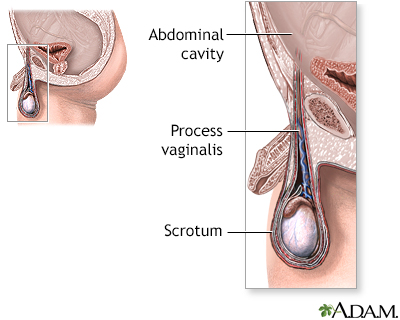
During development, the scrotal cavity in boys is connected to the abdominal cavity via a structure called the processus vaginalis. The processus vaginalis usually closes at birth, or soon after.
Indications
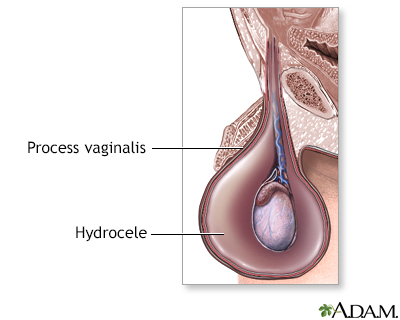
When the processus vaginalis does not close, or closes after fluid from the abdomen has become trapped in the scrotal cavity, it is called a hydrocele. The canal (inguinal canal) between the abdominal cavity (peritoneum) and the scrotum remains open. Fluid from the peritoneum enters the canal and the scrotum, and causes swelling of the scrotum. In some cases, bowel can also pass through the processus vaginalis into the scrotum. This is called an inguinal hernia. If a hydrocele persists past the first 6 to 12 months of life, it should be surgically repaired. Inguinal hernia in infants is usually repaired within the first 3 months of life. It is sometimes difficult to distinguish a hydrocele from an inguinal hernia on exam.
Procedure
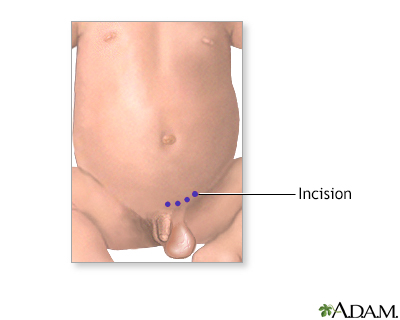
While the baby is deep asleep and pain-free (general anesthesia), an incision is made just above the groin. The open canal between the abdominal cavity and scrotum (inguinal canal) is repaired, the fluid is removed from the scrotum, and the incision is closed.
Aftercare
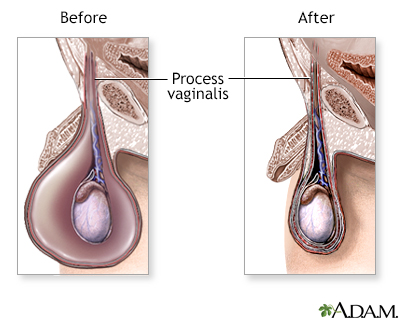
Surgery usually completely corrects the defect, and the long-term prognosis is quite excellent. Hydrocele repair is done on an outpatient basis and recovery is usually brief. Most children can return to normal activity within about four to seven days.
Related Information
Hydrocele repairBACK TO TOP
Review Date: 1/1/2025
Reviewed By: Kelly L. Stratton, MD, FACS, Associate Professor, Department of Urology, University of Oklahoma Health Sciences Center, Oklahoma City, OK. Also reviewed by David C. Dugdale, MD, Medical Director, Brenda Conaway, Editorial Director, and the A.D.A.M. Editorial team.

Health Content Provider
06/01/2028
|
A.D.A.M., Inc. is certified by URAC, for Health Content Provider (www.urac.org). URAC's certification program is an independent audit to verify that A.D.A.M. follows rigorous standards of quality and accountability. A.D.A.M. is among the first to achieve this important distinction for online health information and services. Learn more about A.D.A.M.'s editorial policy, editorial process and privacy policy. |
The information provided herein should not be used during any medical emergency or for the diagnosis or treatment of any medical condition. A licensed medical professional should be consulted for diagnosis and treatment of any and all medical conditions. Links to other sites are provided for information only -- they do not constitute endorsements of those other sites. No warranty of any kind, either expressed or implied, is made as to the accuracy, reliability, timeliness, or correctness of any translations made by a third-party service of the information provided herein into any other language.
© 1997-
2026 A.D.A.M., a business unit of Ebix, Inc. Any duplication or distribution of the information contained herein is strictly prohibited.
All content on this site including text, images, graphics, audio, video, data, metadata, and compilations is protected by copyright and other intellectual property laws. You may view the content for personal, noncommercial use. Any other use requires prior written consent from Ebix. You may not copy, reproduce, distribute, transmit, display, publish, reverse-engineer, adapt, modify, store beyond ordinary browser caching, index, mine, scrape, or create derivative works from this content. You may not use automated tools to access or extract content, including to create embeddings, vectors, datasets, or indexes for retrieval systems. Use of any content for training, fine-tuning, calibrating, testing, evaluating, or improving AI systems of any kind is prohibited without express written consent. This includes large language models, machine learning models, neural networks, generative systems, retrieval-augmented systems, and any software that ingests content to produce outputs. Any unauthorized use of the content including AI-related use is a violation of our rights and may result in legal action, damages, and statutory penalties to the fullest extent permitted by law. Ebix reserves the right to enforce its rights through legal, technological, and contractual measures.
 All rights reserved.